Introduction: The End of an Era
The rules that governed global commerce for four decades are being rewritten. What began as targeted responses to COVID supply shocks and geopolitical tensions has evolved into comprehensive economic statecraft where market outcomes are subordinated to national strategy.
This is not a temporary deviation. It is a structural shift.
Between 2018 and 2024, the world added over 3,000 new trade-restrictive measures. The composition tells the story: 78% target strategic sectors like semiconductors, critical minerals, and green technology rather than traditional trade goods. Retaliation velocity has collapsed from six months to under 90 days. Each protective move by one nation triggers defensive responses from others, compounding into systemic fragmentation.
We call this framework Modern Mercantilism: the deliberate prioritization of national economic power over global market efficiency.

Key Takeaways
- Structural inevitability: Three converging forces, debt constraints, demographic divergence, and technology competition, make mercantilism the rational policy choice for major economies
- The vicious cycle: High debt forces fiscal activism, which triggers trade retaliation, which fragments financial systems, which raises borrowing costs, reinforcing the initial constraint
- Five pillars of fragmentation: Technology sovereignty, resource nationalism, financial fragmentation, industrial subsidies, and trade realignment are reshaping every sector
- Investment implications: Winners are national champions aligned with state priorities; losers sit on fragile cross-border supply chains
- 30 binary forecasts: We present time-bounded, probability-weighted predictions across each pillar through 2031
The Structural Forces Driving Mercantilism
Modern Mercantilism arises from the convergence of three structural forces that constrain policy options and tilt incentives toward state intervention.
1. Debt Constraints
Advanced economies carry debt loads averaging 268% of GDP on broad measures, with the US near 273% and Japan exceeding 250%. China approaches 300% when including provincial and corporate obligations. These levels constrain monetary stimulus and tilt policy toward direct fiscal intervention.
The arithmetic is unforgiving. Let d represent gross public debt/GDP, i the average nominal interest rate, g nominal GDP growth, and pb the primary balance as a share of GDP. Debt dynamics follow:
Debt stabilization requires pb to be approximately 5% of GDP, year after year, when d = 250% and i - g = 2%.
Few democracies can sustain such surpluses politically. Facing this arithmetic, states reach for three levers:
- Financial repression to push interest rates below market levels
- Industrial policy and selective protection to raise growth
- Capital flow management to contain outflows and lower funding risk
These levers, used concurrently across major economies, fragment the global system further.
The Empirical Evidence: Debt Ladders Protectionism
Our analysis of G20 economies reveals a striking correlation between debt levels and trade intervention. Countries with total credit below 100% of GDP averaged just 479 harmful interventions between 2018-2025. But cross the 100% threshold and the number doubles to 987. Above 200%, it nearly doubles again to 1,810, a 4x multiplier effect from the lowest to highest bracket.
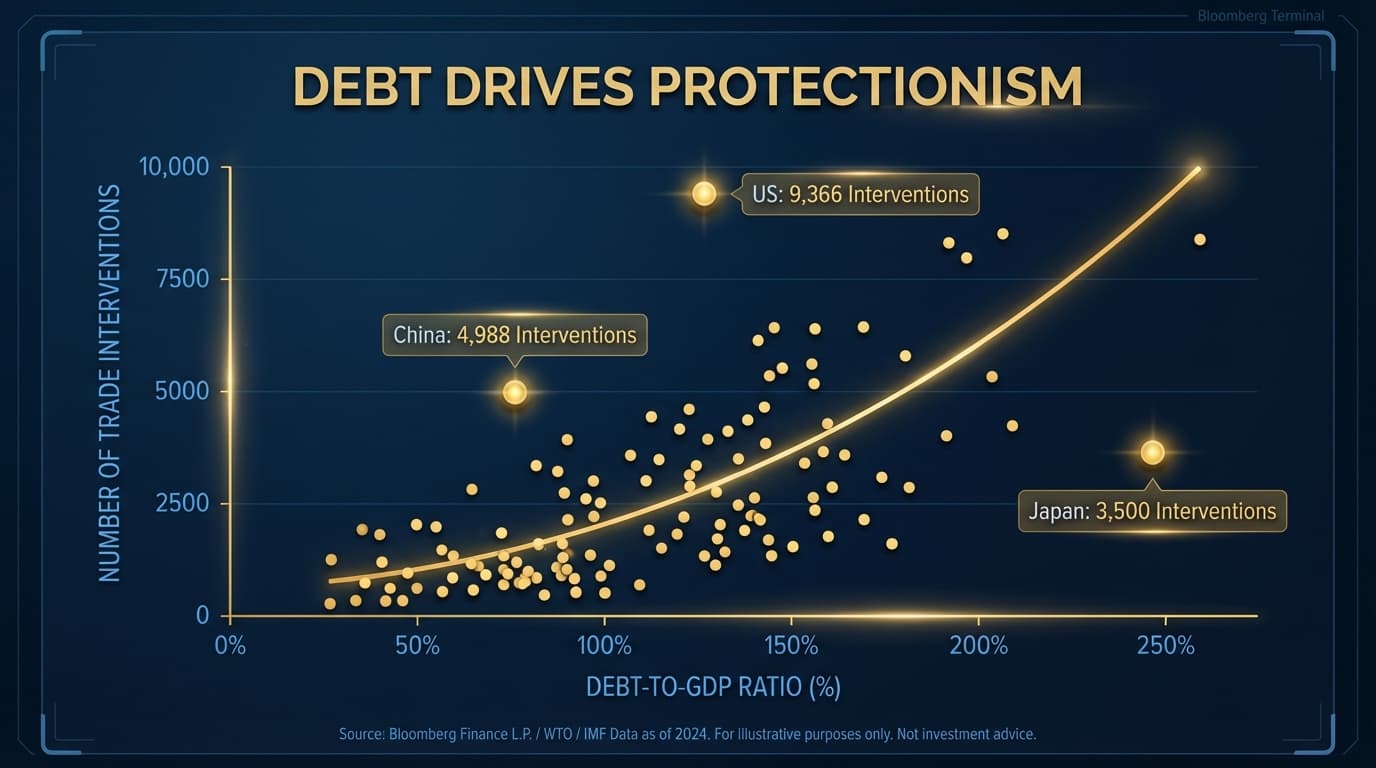
The outliers tell the story even more dramatically. The United States, with total credit approaching 350% of GDP, has implemented a staggering 9,366 trade interventions. China, at roughly 310%, has implemented 4,988. Japan sits in a category of its own since domestic creditors and extraordinary monetary policy create unique dynamics. Meanwhile, lower-leverage economies like Indonesia (40%) and Mexico (50%) maintain relatively open policies, not from ideological commitment but from the simple absence of fiscal pressure forcing intervention.
The policy implication is uncomfortable but unavoidable: high debt levels don't merely correlate with protectionism; they cause it. When monetary policy is exhausted and fiscal space is constrained, trade policy becomes the last remaining lever. The 2020-2024 period shows the steepest acceleration as pandemic debt pushed more countries over the critical 100% threshold. This is not coincidence; it is mechanism.
2. Demographic Divergence
Older advanced economies sit near a mid-40s median age (EU approximately 44.7), while key emerging economies are far younger (India approximately 28). This split encourages wealth-defense and protectionism in the former, and capacity-building and expansion in the latter.
Japan's shrinking workforce cannot staff new factories regardless of subsidies. Europe's pension obligations consume fiscal space that might otherwise fund industrial policy. Meanwhile, India adds Australia's population equivalent every 18 months, and Africa will add one billion people by 2050.
This demographic asymmetry creates fundamentally different policy imperatives. Aging societies protect existing wealth; young societies build new capacity. Both impulses lead to mercantilism, but of different varieties.
3. Technology Maturation
Performance scaling now requires capital investment that only states can mobilize. Leading-edge semiconductor fabs cost $20-30 billion. The energy transition requires $4-6x current mineral production by 2040. AI infrastructure demands power and compute at scales that strain private balance sheets.
Governments are filling the gap through state-backed champions and subsidies. The semiconductor subsidy race exemplifies this transformation:
The Semiconductor Subsidy Arms Race (2020-2025 Announced Packages)
| Country | Total Support (USD) | Support Intensity | Primary Mechanism |
|---|---|---|---|
| China | $150B+ | 63% of project costs | Direct grants + equity stakes |
| United States | $280B | 28% of project costs | Tax credits + grants |
| European Union | €43B (~$47B) | 33% of project costs | Grants + loans |
| South Korea | $65B | 44% of project costs | Tax credits (25%+) |
| Japan | $25B | 23% of project costs | Subsidies + land |
| Taiwan | $10B | 25% of project costs | Tax incentives |
Global semiconductor subsidies exploded from under $50 billion pre-2020 to over $300 billion announced by 2025, marking the return of industrial policy at unprecedented scale. Support intensity ranges from 20% (US) to 40%+ (China/EU) of project costs through grants, tax credits, and equity stakes.
The economics are stark: a leading-edge fab costs $20-30 billion. With 40%+ subsidies, private investment cannot compete without state backing. Technology leadership becomes a function of fiscal capacity rather than innovation alone. The subsidy race validates our forecast that state support will determine winners in frontier technologies.
The Vicious Cycle of Modern Mercantilism
These forces interact in a self-reinforcing loop that accelerates fragmentation. The mechanics are brutally straightforward, and once you understand them, the policy trajectory becomes predictable.
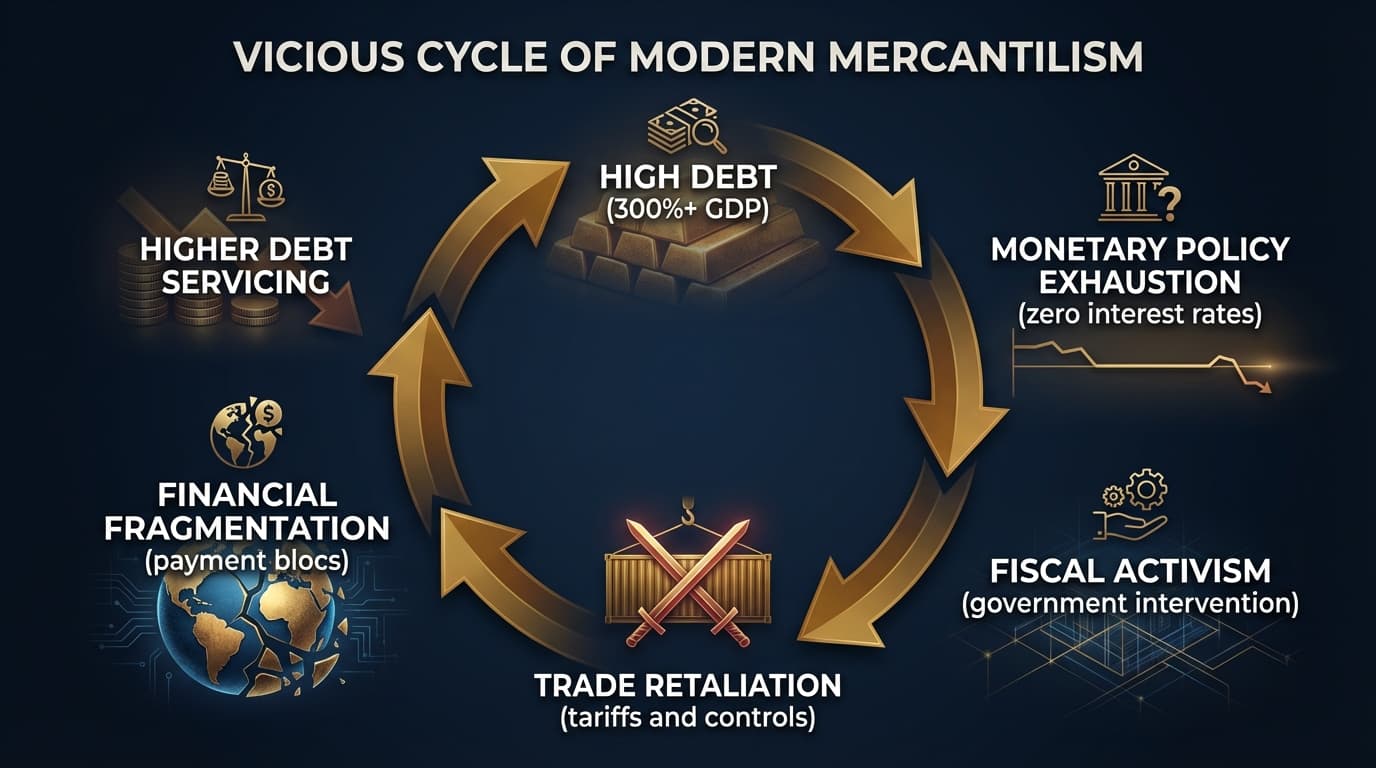
When public debt exceeds critical thresholds (250% of GDP in Japan, approaching 275% in the United States, 310% in China) traditional monetary policy loses effectiveness. Central banks that have already pushed rates to zero or negative territory find themselves unable to stimulate growth through conventional means. This monetary exhaustion forces governments toward direct intervention.
That intervention takes the form of massive fiscal activism: subsidies, local content requirements, and strategic sector support. The CHIPS Act commits $280 billion. The EU Green Deal Industrial Plan deploys hundreds of billions more. China's Big Fund and provincial programs exceed $150 billion in semiconductors alone. This is not stimulus; it is structural transformation where governments pick winners directly.
But fiscal activism in one nation triggers defensive responses from trading partners. Trade retaliation has accelerated dramatically. Average response time has collapsed from six months to under 90 days. When America announces semiconductor subsidies, Europe responds within weeks. When Europe imposes carbon border adjustments, trading partners file WTO complaints and plan counter-tariffs. Each intervention breeds counter-intervention.
The cascade continues into financial fragmentation. As trust erodes, nations diversify reserves away from potentially weaponized currencies. Alternative payment systems bypass SWIFT. Capital controls proliferate. Central banks hoard gold at triple historical rates. Borrowing costs rise for nations outside preferred blocs, fragmenting what was once a unified global capital market.
Higher debt servicing then completes the loop, reinforcing the original constraint. Fragmented markets raise risk premia, increasing interest costs, tightening fiscal space, and forcing yet more intervention. The cycle feeds on itself.
Historical precedent is sobering. Similar dynamics in the 1930s led to a decade of economic nationalism, competitive devaluations, and ultimately conflict. Today's public debt levels in many countries exceed those Depression-era peaks, suggesting more persistent state intervention ahead.
The Five Pillars of Modern Mercantilism
We organize the mercantile transformation into five interconnected risk clusters. Each represents a distinct policy arena with specific investment implications.
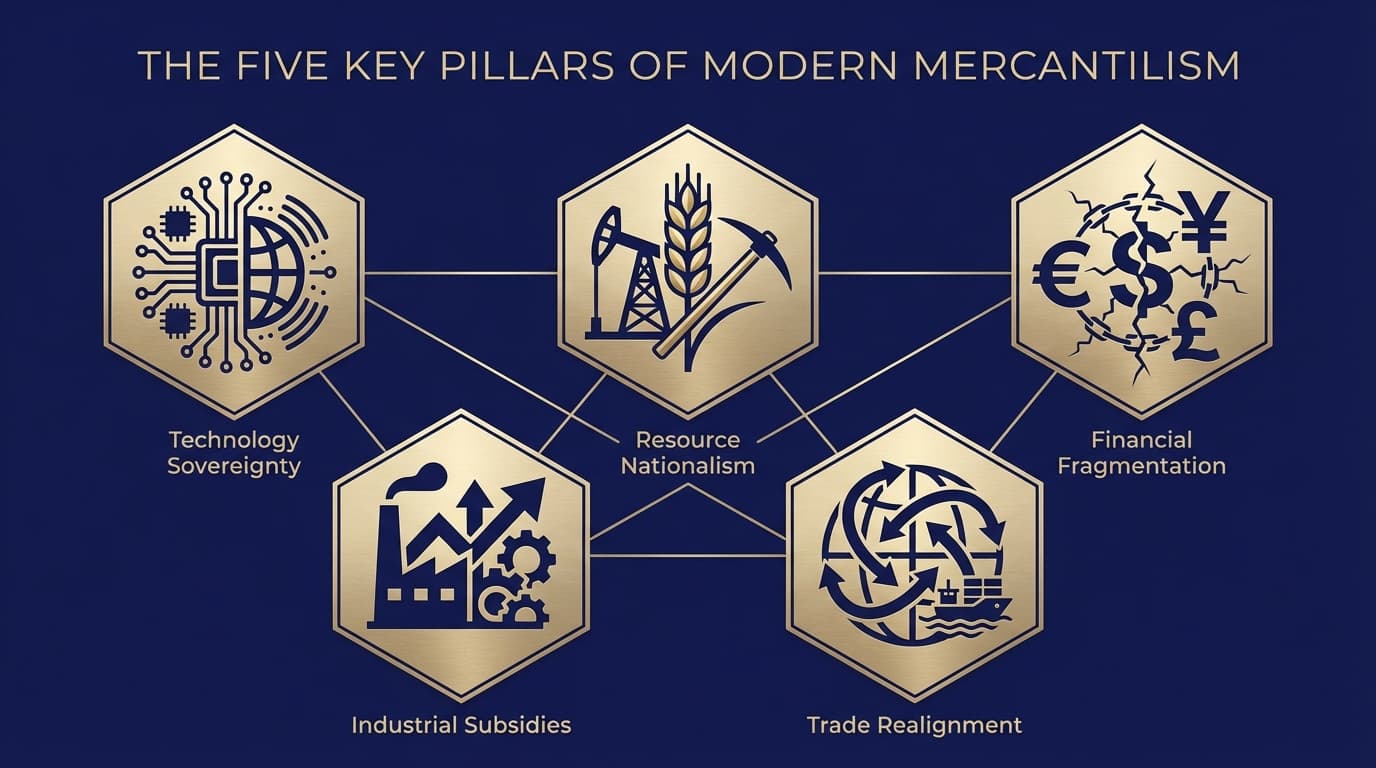
Pillar 1: Technology and AI Sovereignty
State-mandated tech standards fragment global platforms as governments orchestrate economic outcomes.
Nations are using regulatory power to fracture once-unified digital markets into sovereign spheres of control. Export licenses, data localization mandates, and technical standards now decide who can compete globally.
The US is capping exports of cutting-edge AI chips to rivals. By 2028, we forecast an 80% probability that GPU exports to China will be limited to 10% of 2023 levels via Commerce license quotas. Indonesia, Vietnam, and other ASEAN nations will likely publish AI licensing regimes banning foreign large-language model APIs that are not locally registered.
China will mandate domestic IoT security standards excluding Western tech firms from its $100 billion+ market. Taiwan will bar semiconductor investment in sub-3nm fabs from companies based in unfriendly nations. The UK will require sovereign-compute certificates for AI deployment in critical infrastructure.
Read the full analysis: Technology and AI Sovereignty
Pillar 2: Resource Nationalism
Physical commodity control prioritizes national power over global market efficiency.
Critical materials have become instruments of statecraft. China dominates rare earths (69% of production), gallium (98%), and graphite (77%). Seven of fifteen critical minerals already face export controls. The multiplier effect is severe: China's mining share becomes 85%+ in processing, creating dual chokepoints.
Russia will price at least 50% of oil exports in Chinese yuan or other non-USD currencies by 2030, breaking the 50-year petrodollar system. Brazil will tax agricultural exports to fund domestic fertilizer subsidies. Nigeria will impose lithium export duties. G20 agricultural exporters will coordinate wheat and rice quotas following climate events.
Historical pattern: each restriction triggers 50-150% price spikes within six months. With the green transition requiring 4-6x current mineral production by 2040, these chokepoints become the new geopolitical flashpoints.
Read the full analysis: Resource Nationalism
Pillar 3: Financial Fragmentation
Weaponized finance drives alternative payment architectures as nations decouple from dollar hegemony.
The dollar's share of global reserves has declined from 71% in 2000 to 58% by 2024. Gold's share doubled from 11% to 22% over the same period, representing the most dramatic shift in reserve composition since Bretton Woods collapsed.
Central banks added 1,100+ tonnes of gold annually in 2022-2024, triple the 2010-2019 average. The acceleration began with 2022 Russian sanctions, which demonstrated that USD reserves can be weaponized. Non-aligned nations (Turkey, India, China) lead gold accumulation, while sanctioned nations (Russia, Iran) dumped dollars entirely.
We forecast a 10% probability of a failed US Treasury auction (bid-to-cover below 0.5) between 2027-2031. The Treasury will pilot allied-only digital clearing networks for tokenized Treasuries. BRICS+ members will process over 30% of bilateral trade through non-SWIFT mechanisms by 2028, with digital yuan handling $500 billion or more annually.
Read the full analysis: Financial Fragmentation
Pillar 4: Industrial Subsidies and Local Content
Competitive subsidies protect national champions, replacing currency wars with fiscal wars.
Where globalists once preached open markets, mercantilist policymakers practice selective protectionism. Governments are pouring fiscal firepower into key sectors to ensure domestic champions win while others lose.
The semiconductor subsidy arms race exemplifies this transformation. Support intensity ranges from 20% of project costs (US) to 40%+ (China/EU) through grants, tax credits, and equity stakes. A leading-edge fab costs $20-30 billion; with 40%+ subsidies, private investment cannot compete without state backing.
China will nationalize at least one top-three private EV maker by 2030. India will mandate domestically manufactured solar panels for government projects. Mexico will require 25% local content in semiconductor assembly for US exports. The EU will require 40% local production for critical medicines. South Korea's semiconductor investment tax credit will exceed 25%, surpassing even US incentives.
Read the full analysis: Industrial Subsidies and Local Content
Pillar 5: Trade Realignment and Defense
Security-driven industrial policy redefines global commerce and competition.
Industrial policy and national security have effectively fused. Governments are not only subsidizing peacetime industries but redirecting defense and high-tech procurement to favor allies and punish adversaries.
US goods imports from China fell 22% (2018-2023) while Mexico surged 55%, Vietnam jumped 121%, and broader ASEAN rose 47%. Mexico overtaking China as America's top supplier in 2023 marks the most dramatic trade realignment since World War II. Cross-bloc trade (US-China) consistently underperforms intra-bloc flows (US-Mexico/ASEAN) by double digits since 2022.
By 2030, at least one major economy will formally withdraw from the WTO. The IMF will agree to a BRICS-backed quota increase reducing G7 combined voting share below 50%. Shipyards in NATO, AUKUS, Japan, and South Korea will capture over 50% of global naval vessel orders worth $150 billion or more annually. Defense spending now serves dual purposes: military readiness and economic containment of adversaries.
Read the full analysis: Trade Realignment and Defense
Navigating the Mercantilist Reality
Investing in this environment is about picking countries and supply chains, not just companies. Winners are national champions and resource holders aligned with state priorities. Losers sit on fragile cross-border links.
The New Portfolio Framework
The new reality demands portfolio construction that acknowledges geopolitical risk as a primary factor, not an afterthought. Traditional diversification fails when correlations spike during bloc-based conflicts.
Overweight:
- Policy-favored champions with state backing and protected domestic markets
- Resource assets with structural scarcity and limited substitutes
- Non-sovereign stores of value (gold, select real assets) as insurance
- Cross-border fragile firms with operational flexibility to relocate supply chains
Underweight:
- Companies dependent on frictionless cross-border flows
- Purely financial intermediaries exposed to payment system fragmentation
- Industries facing both bloc competition and subsidy disadvantages
Hold volatility insurance:
- Geopolitical risk no longer mean-reverts quickly
- Correlation spikes during bloc conflicts require explicit hedging
- Traditional 60/40 diversification provides inadequate protection
Read the full analysis: Investment Implications
Conclusion: The Decade of State Capitalism
Modern Mercantilism is not a policy choice. It is a structural outcome.
When debt constrains monetary policy, when demographics split the world into aging defenders and young builders, when technology leadership requires state-scale capital deployment, governments reach for mercantilist tools regardless of ideology. The prisoner's dilemma dynamic forces even nations that prefer openness into defensive responses.
The result is an accelerating breakdown of the post-1945 liberal order. Not through ideology, but through rational self-interest. Each protective move by one nation triggers defensive responses from others, creating cascading interventions that compound into systemic change.
What began as targeted responses to COVID supply shocks and geopolitical tensions has evolved into comprehensive economic statecraft. The next decade will be defined by this transformation.
For investors, the implications are profound. The old playbook of global diversification and market efficiency must be supplemented with explicit geopolitical analysis. Country selection matters more than sector selection. Supply chain resilience matters more than cost optimization. State alignment matters more than pure fundamentals.
The rules have changed. The winners will be those who recognize it first.
The Research Series
This analysis is the first in a seven-part series examining Modern Mercantilism and its investment implications:
- Modern Mercantilism: The Investment Thesis (This article)
- Technology and AI Sovereignty
- Resource Nationalism
- Financial Fragmentation
- Industrial Subsidies and Local Content
- Trade Realignment and Defense
- Investment Implications
Each deep-dive includes specific binary forecasts, probability weights, and actionable investment frameworks.