
Introduction: The End of Financial Unipolarity
For eight decades, global finance operated through a single system. Dollar dominance, SWIFT messaging, and US-centered capital markets created an integrated architecture where capital flowed according to return maximization. That era is ending.
The weaponization of financial infrastructure, from sanctions to asset freezes to SWIFT exclusions, has demonstrated that participation in the dollar system carries political risk. Nations are responding by building alternatives. Not because these alternatives are more efficient, but because they offer strategic autonomy.
Key Takeaways
- Dollar erosion, not collapse: USD share of reserves has fallen from 71% (2000) to 58% (2024), a gradual decline rather than sudden displacement
- Record central bank gold purchases: 1,000+ tonnes purchased annually in 2022-2024, triple the 2010-2019 average, as nations seek sanction-proof reserves
- BRICS payment alternatives: 55% probability that BRICS payment systems handle 5%+ of member trade by 2028, creating parallel financial infrastructure
- Treasury market stress risk: 35% probability of a failed Treasury auction requiring Fed intervention by 2030
- Weaponization premium: Nations accepting 2-5x higher transaction costs for financial sovereignty and reduced dependence on dollar systems
- Investment positioning: Overweight gold, diversify currency exposure, favor cross-border payment infrastructure benefiting from complexity
The De-Dollarization Thesis
Why Dollar Dominance Persists (For Now)
Despite headlines proclaiming the dollar's demise, the greenback's position remains formidable. The USD still commands 58% of global foreign exchange reserves, down from 71% in 2000, but still more than triple its nearest competitor. SWIFT payment data shows the dollar handling 47% of international transactions, a share that has remained remarkably stable even as alternatives emerge. In trade invoicing, dollar dominance is even more pronounced: 88% of Americas trade and 74% of Asian trade still prices in USD. Commodity markets remain overwhelmingly dollar-denominated, with over 80% of global oil, metals, and agricultural trade settling in greenbacks.
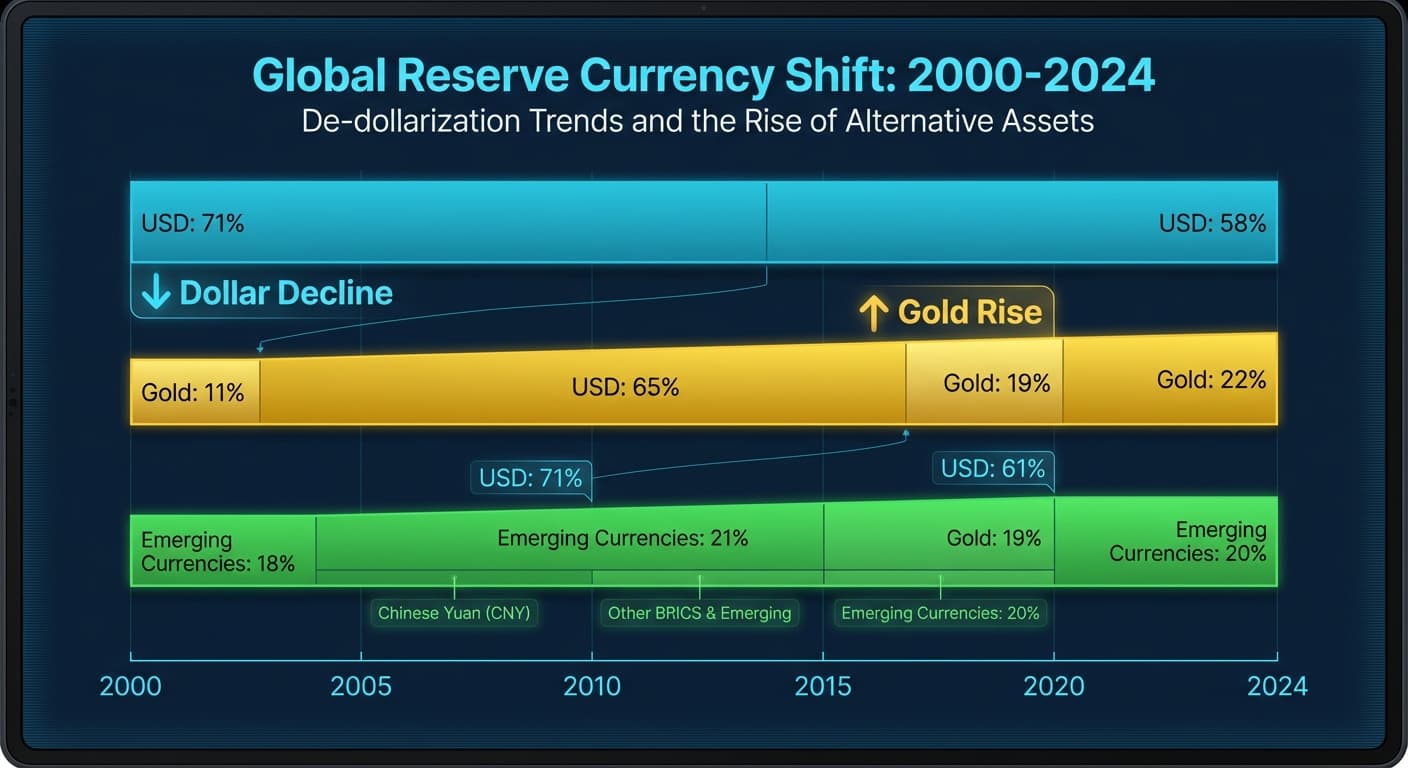
Why does this dominance persist? Network effects create powerful inertia as liquidity begets liquidity, and the dollar's deep markets mean lower transaction costs for everyone using the system. No alternative matches the depth of US capital markets; the Treasury market alone exceeds $25 trillion. Dollar contracts benefit from 80 years of established legal jurisprudence, while alternatives operate in legal gray zones. And switching costs are substantial: rewiring the plumbing of global finance requires coordination across thousands of institutions simultaneously.
The Forces Driving Fragmentation
However, structural forces are eroding dollar hegemony:
1. Sanctions Weaponization
The freezing of $300B in Russian central bank reserves crossed a Rubicon. Central banks worldwide recognized that dollar assets carry confiscation risk. The response has been immediate: record gold purchases and diversification into alternative currencies.
2. US Fiscal Trajectory
US debt-to-GDP has breached 120%. Annual deficits run $2T+. Foreign appetite for Treasuries is declining as foreign holdings have dropped from 34% to 23% of outstanding debt since 2014. At some point, fiscal sustainability concerns will erode confidence in the dollar's long-term value.
3. Technology Enables Alternatives
CBDCs, blockchain-based settlement, and bilateral currency arrangements reduce dependence on SWIFT and correspondent banking. Technology is lowering the switching costs that historically protected dollar dominance.
Key Forecasts: Financial System Stress
Treasury Market Dysfunction
The bedrock of global finance is showing cracks. We assign 35% probability to a failed Treasury auction requiring Fed intervention by 2030, an event that would have been unthinkable a decade ago. More likely (60% probability) is foreign Treasury holdings falling below 20% of outstanding debt, down from 34% in 2014. And there's a meaningful 40% chance the Fed implements formal yield curve control to manage the government's borrowing costs.
The structural fragility is real. Record issuance ($2+ trillion annual deficits), declining foreign demand (China and Japan reducing holdings), and reduced dealer capacity (post-2008 regulations limit balance sheet usage) create conditions for stress. The 2019 repo crisis and 2020 Treasury selloff previewed what dysfunction looks like. A failed auction, where primary dealers cannot absorb issuance, would force Fed intervention and potentially accelerate de-dollarization as confidence erodes.
For investors, Treasury market stress creates opportunities in gold, inflation hedges, and alternative reserve assets. Maintain shorter duration to reduce volatility from yield spikes.
BRICS Payment Alternatives
The BRICS bloc, now expanded to include UAE, Egypt, Ethiopia, Iran, and Indonesia, is building parallel financial infrastructure. We forecast 55% probability that BRICS payment systems handle more than 5% of member trade by 2028. A common BRICS trade currency has only 30% odds by 2030 (the coordination challenges are immense), but bilateral arrangements are proliferating. India-Russia bilateral trade has a 45% chance of exceeding $100 billion by 2028.
China's CIPS system processed $14.5 trillion in 2023, up 25% year-over-year. Russia-China trade has shifted to 90%+ yuan/ruble settlement. These aren't theoretical alternatives; they're operational systems handling real volume.
The challenge is coordination. A true BRICS currency would require agreement on governance (improbable given China-India border tensions), surrender of monetary sovereignty (politically unacceptable in any major economy), and clearing infrastructure that doesn't yet exist at scale. More likely: a patchwork of bilateral arrangements rather than a unified alternative. This is sufficient to reduce dollar dependence but insufficient to replace dollar centrality entirely.
Financial infrastructure providers serving BRICS trade corridors benefit from this transition. Chinese banks, cross-border payment fintechs, and commodity exchanges in non-dollar jurisdictions gain structural importance.
Central Bank Gold Accumulation
The gold rush is real and accelerating. Central banks purchased 1,037 tonnes of gold in 2023, the second-highest annual total on record, and we assign 70% probability that purchases exceed 1,200 tonnes annually by 2027. China's gold reserves have a 50% chance of exceeding 5,000 tonnes by 2030. Across emerging markets, gold could surpass 20% of central bank reserves (45% probability).
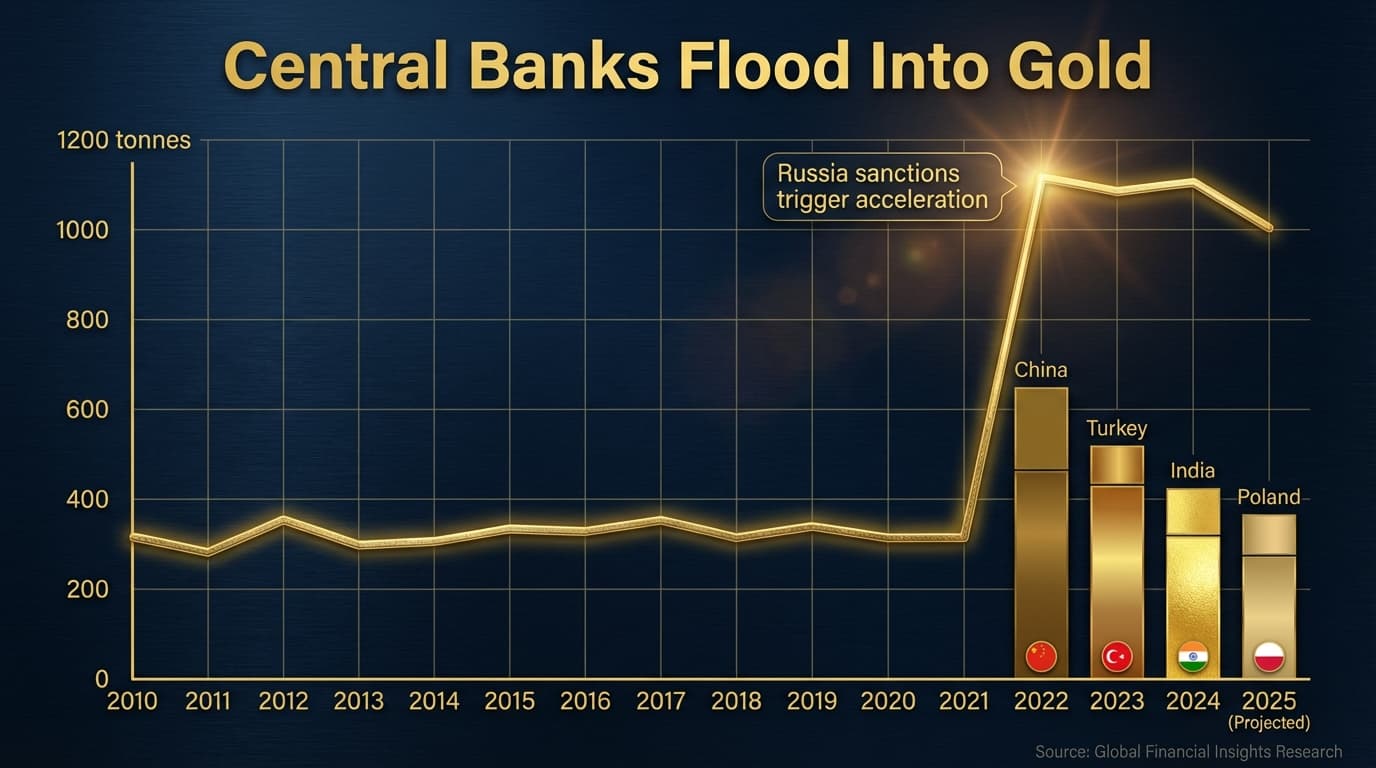
The composition tells the story. China, Turkey, India, and Poland dominate purchases, all nations building strategic autonomy from dollar-centric systems. Gold serves three critical functions in this context. First, it's sanction-proof: gold held domestically cannot be frozen like dollar assets (the lesson from $300 billion in frozen Russian reserves). Second, it hedges against fiat currency debasement as major central banks expand balance sheets. Third, it provides a potential settlement asset for bilateral trade arrangements that bypass the dollar.
Central bank purchases represent price-insensitive accumulation that supports gold prices independent of retail sentiment. Portfolio allocation of 5-10% to gold and gold equities provides insurance against monetary system stress.
The Weaponization Premium
The Cost of Financial Sovereignty
Participating in alternative financial systems carries real costs. Transaction costs run 2-5x higher than dollar-based systems, the price of thinner markets and less developed infrastructure. Liquidity is substantially lower, meaning large transactions move markets more. Legal certainty is underdeveloped; disputes in yuan-denominated contracts lack the 80 years of precedent that dollar contracts enjoy. Settlement times are often slower, with multi-day clearing replacing the instant finality of dollar systems.
Nations accept these costs because the alternative, dependence on a system that can be weaponized against them, carries strategic risk. This "weaponization premium" represents the price countries pay for financial sovereignty. When evaluating fragmentation, the key question is: which matters more to this country, transaction costs or geopolitical alignment? Sanctioned nations and US adversaries prioritize alternatives regardless of cost. Aligned nations continue dollar system participation. The middle tier (India, Brazil, Saudi Arabia, Indonesia) will maintain dual access, using each system as leverage against the other.
The Rise of SWIFT Alternatives
SWIFT's neutrality ended with Russian exclusion. Before 2022, the Belgium-based messaging system operated as neutral infrastructure. Now it's understood as a weapon that can be deployed against any nation Washington deems an adversary.
China's CIPS (Cross-Border Interbank Payment System) represents the most credible alternative, with over 1,400 participating banks and $14.5 trillion in transactions processed in 2023. Russia's SPFS handles domestic messaging for 400+ banks but lacks the international reach to serve as a true alternative. The EU's INSTEX, designed to facilitate Iran trade, effectively failed, unable to achieve meaningful volume. The BIS-sponsored mBridge project, testing central bank digital currency cross-border settlement, remains in pilot phase.
The gap is clear: CIPS has scale but remains dependent on SWIFT messaging for many international transactions. True independence requires both messaging and clearing alternatives. That gap will narrow over the next decade as geopolitical incentives drive infrastructure investment.
Regional Analysis: Fragmentation by Geography
Asia: Yuan Internationalization
China's yuan internationalization progresses steadily if unevenly. The yuan's share of trade settlement has risen from effectively zero in 2010 to 4.5% by 2024, meaningful progress but still a fraction of dollar dominance. Yuan foreign exchange trading has reached 7% of global turnover, making it the fifth most traded currency. Belt and Road lending is increasingly yuan-denominated, creating natural demand for the currency across developing nations receiving Chinese infrastructure investment.
Constraints: Capital controls fundamentally limit the yuan's reserve currency potential. China prioritizes domestic monetary control over international currency status; Beijing refuses to sacrifice policy flexibility for reserve currency prestige. Yuan internationalization will be gradual, sector-specific, and politically directed rather than market-driven.
Gulf States: The Petroyuan Question
Saudi Arabia's openness to yuan oil settlement sent shockwaves through markets. However, structural factors limit the shift. The dollar peg provides monetary stability that Saudi Arabia has no interest in abandoning since it has anchored economic policy for four decades. Recycling petrodollars into US assets represents a structural relationship that delivers security guarantees alongside financial returns. Complete petrodollar abandonment would strain the US-Saudi relationship in ways that bring real costs.
More likely: selective yuan settlement for Chinese oil purchases while maintaining dollar primacy for the bulk of Saudi exports. Strategic optionality rather than wholesale switch: Saudi Arabia gains leverage from the threat of diversification without bearing the costs of actually executing it.
Africa and Emerging Markets

African nations face acute dollar shortage and dollar debt burdens that make alternatives genuinely attractive. Bilateral currency agreements proliferate, and China-Kenya and Russia-Ethiopia arrangements allow trade settlement without dollar conversion. Local currency trade settlement gains traction as countries seek to avoid dollar shortages that constrain commerce. BRICS membership interest from multiple African nations reflects the desire for alternatives to Western-dominated financial architecture.
Investment Implication: Financial infrastructure supporting Africa-Asia trade corridors presents opportunity. Payment systems, trade finance, and FX platforms serving non-dollar corridors benefit from structural growth as these relationships deepen.
Investment Implications
Asset Class Views
Gold deserves an overweight allocation. Central bank accumulation provides structural demand regardless of retail sentiment, while gold's sanction-proof nature makes it increasingly attractive to reserve managers worried about asset freezes.
Emerging market currencies require selectivity. Focus on current account surplus nations with strong fiscal positions since not all EM currencies benefit equally from de-dollarization. Countries with structural external surpluses (parts of Asia, commodity exporters) outperform deficit nations in a fragmenting system.
Developed market bonds warrant an underweight. Fiscal concerns, reduced foreign demand, and the potential for yield curve control all argue for caution. The risk-reward in long-duration sovereign debt has deteriorated significantly.
BRICS financial infrastructure represents a selective buying opportunity. Banks and institutions serving non-dollar trade corridors gain structural importance. Chinese banks with international networks, commodity exchanges handling yuan-denominated contracts, and regional payment processors all benefit.
Cross-border payment fintechs are a buy. Financial fragmentation means complexity, and complexity rewards firms that can navigate it. Payment companies with multi-currency capability and diverse banking relationships gain competitive moats.
Portfolio Positioning
For USD-based investors, several adjustments address fragmentation risk. Maintain gold allocation as monetary insurance in the 5-10% range, which provides meaningful protection without excessive opportunity cost. Diversify currency exposure to CHF and SGD for stability, as these currencies offer alternative safe-haven properties backed by sound fiscal positions. Selective emerging market exposure in India, Indonesia, and Mexico captures the growth story while maintaining reasonable governance standards. Reduce long-duration Treasury exposure given the fiscal concerns and potential for yield curve control that would disadvantage long-dated holders.
For non-USD investors, the transition offers distinct opportunities. Benefit from fragmentation by proactively reducing USD operational dependence before it becomes necessary under stress. Access China A-shares and onshore yuan markets directly rather than through Hong Kong-listed alternatives, building operational capability that will prove valuable as yuan markets deepen. Consider gold as reserve allocation with the same logic driving central bank purchases: sanction-proof, inflation-hedged, and universally accepted.
Opportunities in Complexity
Financial fragmentation creates friction. Friction creates opportunity for those who can navigate complexity that deters less capable competitors.
Trade finance offers perhaps the clearest opportunity. As traditional correspondent banking retreats from certain corridors (whether due to sanctions compliance, profitability concerns, or de-risking policies) alternative providers fill gaps with higher returns that compensate for operational complexity. Foreign exchange in illiquid currency pairs commands wider spreads; market makers with operational capability and balance sheet capacity profit from providing liquidity that others cannot. Cross-border payments generate complexity premiums for firms that can route transactions through fragmenting infrastructure, maintaining multiple banking relationships across competing financial systems. Commodity trading advantages flow to physical traders with multi-currency capability and diverse banking relationships, as the ability to settle in any major currency and transact through any major financial center creates competitive moat.
Conclusion: The New Financial Geography
Financial fragmentation is not a crisis; it is a transition. The efficient, dollar-centered system served US hegemony and global commerce simultaneously. That alignment is fracturing.
What emerges will be messier, more expensive, and less efficient. But it will also reflect genuine geopolitical realities rather than assuming US-led unipolarity. Investors who understand this transition and can operate across fragmenting systems will find opportunity in complexity.
The dollar's dominance will erode gradually rather than collapse suddenly. Alternative systems will grow in importance without achieving dollar-equivalent depth. The result: financial multipolarity, with higher transaction costs offset by reduced geopolitical dependence.
Position for this transition not by abandoning dollar assets, but by building optionality. Gold provides monetary insurance. Diversified currency exposure reduces single-system dependence. Investment in financial infrastructure serves whichever system prevails.
Series Navigation
This article is part of our comprehensive Modern Mercantilism research series: