
Introduction: A New Investment Paradigm
The preceding analyses in our Modern Mercantilism series have examined technology sovereignty, resource nationalism, financial fragmentation, industrial subsidies, and trade realignment. Each represents a dimension of the same underlying shift: governments are subordinating market efficiency to national strategic interests.
For investors, this creates both challenge and opportunity:
The Challenge: Traditional valuation frameworks assume market-determined outcomes. When governments actively shape markets through subsidies, restrictions, and strategic interventions, historical relationships break down.
The Opportunity: Understanding where policy flows creates asymmetric opportunities. The investors who identified reshoring themes early, positioned for energy transition, or understood semiconductor supply chains have dramatically outperformed.
Key Takeaways
- Policy literacy is the new edge: The next decade rewards investors who understand geopolitical alignment over those relying purely on financial metrics
- Two-axis investment matrix: Categorize investments by policy direction (tailwind vs. headwind) and bloc alignment (allied vs. cross-bloc) to identify structural winners
- Regional allocation: Overweight US (+3% vs. MSCI ACWI), Mexico nearshoring, and select EM beneficiaries; underweight China (-3%) for decoupling risk
- Sector positioning: Overweight semiconductors, defense, clean energy, and grid infrastructure; underweight China-dependent supply chains
- Gold is essential: 5-10% allocation provides sanction-proof insurance against monetary system stress and financial fragmentation
- Complexity creates opportunity: Financial fragmentation rewards investors who can navigate systems that deter less capable competitors
Framework: The Modern Mercantilism Investment Matrix
Categorizing Exposures
We organize investments along two fundamental axes that define the mercantilist investment landscape.
The first axis measures policy direction, whether an investment faces tailwinds or headwinds from government action. Tailwind sectors receive government support through subsidies, protection, or preferential market access. These include semiconductor manufacturing in the US, defense contractors across NATO, and renewable energy benefiting from the IRA. Headwind sectors face restrictions through sanctions, tariffs, or regulatory burden. Chinese technology companies listed on US exchanges, cross-border data services, and industries dependent on adversary supply chains fall into this category.
The second axis measures bloc alignment, whether operations remain within allied systems or span competing geopolitical structures. Aligned operations stay within the investor's home bloc or allied blocs, benefiting from regulatory harmonization and reduced political risk. Cross-bloc operations span competing geopolitical systems, facing both regulatory complexity and the risk of sudden access restrictions.
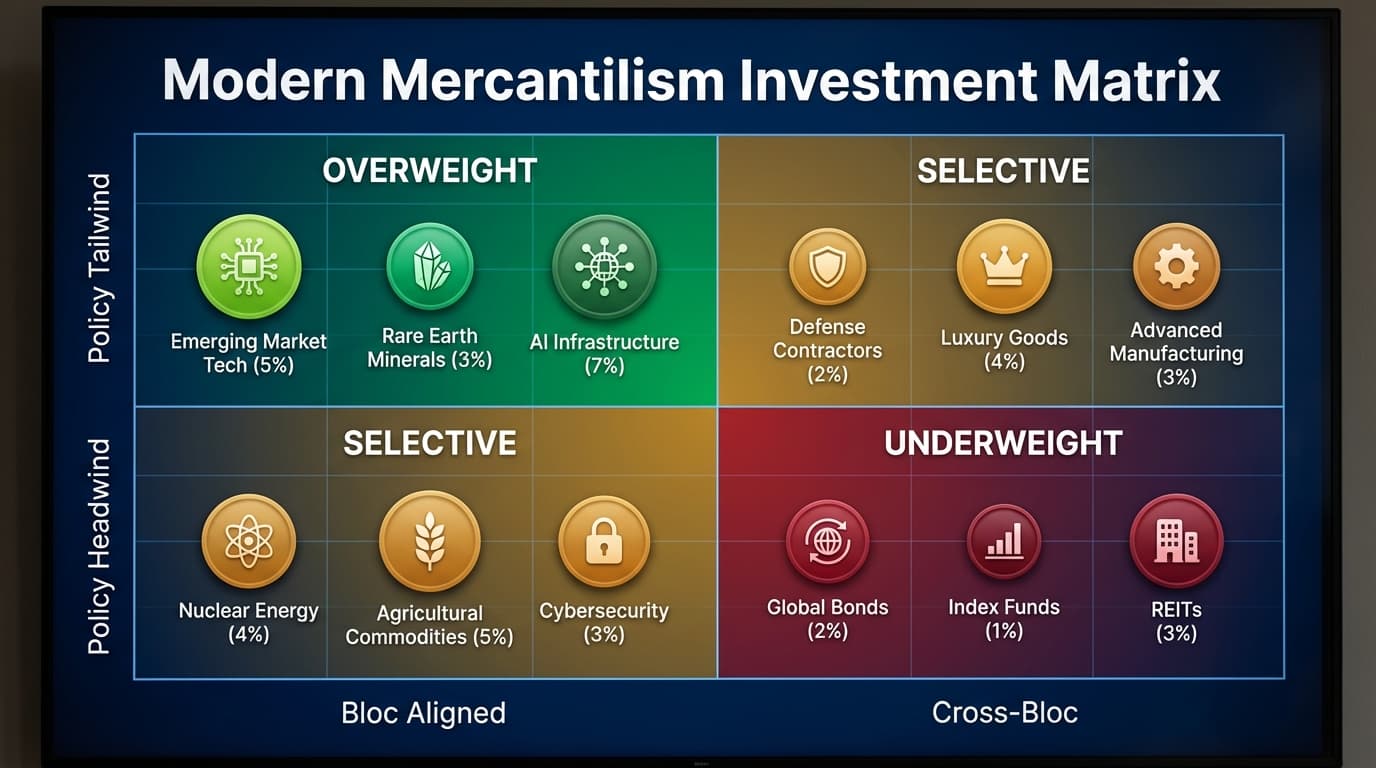
The intersection of these axes creates four quadrants with clear positioning implications.
Bloc-aligned with policy tailwinds deserve maximum overweight: these investments benefit from both government support and favorable jurisdiction. Think US semiconductor manufacturing or European defense contractors. Double tailwinds create compounding advantages.
Bloc-aligned with policy headwinds warrant selective exposure: the alignment provides political safety, but headwinds limit returns. Traditional energy in the US exemplifies this quadrant: no political risk, but policy direction unfavorable.
Cross-bloc with policy tailwinds require selective engagement: the investment thesis may be sound, but operational complexity and political risk demand higher return hurdles. Chinese solar capacity is cheap and scaled, but access risks limit allocation.
Cross-bloc with policy headwinds deserve structural underweight: these positions face compounding disadvantages. Chinese technology companies listed on US exchanges face both decoupling pressure and regulatory burden. Avoid or minimize.
This matrix guides allocation decisions. The strongest positions combine policy tailwinds with bloc alignment. The weakest positions face policy headwinds while operating across competing blocs.
Asset Class Positioning
Equities: Regional and Sector Allocation
United States (Overweight)
The US represents maximum policy tailwind for domestic investors. Over $2 trillion in industrial policy through the IRA, CHIPS Act, and infrastructure legislation creates unprecedented government support for domestic manufacturing and technology. Energy independence provides insulation from the commodity weaponization occurring elsewhere, and the US is not vulnerable to Russian gas cutoffs or OPEC production decisions. Reserve currency status, despite gradual erosion, provides optionality that no other economy enjoys. Deep capital markets attract global capital seeking safety, creating a self-reinforcing cycle of liquidity and stability.
Within US equities, sector positioning reflects policy alignment. Semiconductors deserve strong overweight as the CHIPS Act plus strategic priority status create exceptional tailwinds. Clean energy warrants overweight as the primary IRA beneficiary sector. Defense and aerospace merit overweight for the geopolitical premium now structurally embedded in valuations. Grid infrastructure commands overweight positioning as it's the bottleneck with policy support to address it.
More balanced sectors: Healthcare stays neutral, balancing domestic demand drivers against regulatory risk that cuts both ways. Consumer discretionary tilts underweight due to pervasive China supply chain exposure that creates ongoing vulnerability.
Europe (Selective)
Europe presents mixed dynamics: strong regulatory framework, weak fiscal capacity, energy vulnerability. Sector selection matters more than regional allocation.
Green industrials merit overweight as CBAM protection creates structural advantage for European producers of green steel, low-carbon cement, and sustainable materials. The carbon border tax is a genuine moat. Defense deserves overweight as the rearmament cycle accelerates following decades of underinvestment. Political mandate now aligns with fiscal commitment.
Luxury sits neutral given strong franchises but meaningful China exposure creates ongoing risk as that economy struggles. Autos tilt underweight as the sector fights both EV transition challenges and intensifying Chinese competition. Legacy auto faces perhaps the most difficult competitive environment in its history. Energy-intensive industry warrants underweight as structural cost disadvantage versus US (cheap gas) and China (subsidies) limits competitive positioning.
Emerging Markets (Highly Selective)
Emerging markets bifurcate between nearshoring winners and those caught between blocs. Country selection matters enormously.
Mexico commands strong overweight as the the nearshoring epicenter, already America's largest trading partner, benefiting from USMCA protections and geographic proximity. India warrants selective overweight: the long-term structural story is compelling but execution risk demands careful stock selection. Focus on proven operators. Indonesia deserves overweight as the next wave of China+1 manufacturing relocation combines with commodity resource wealth.
Vietnam moves to neutral after its remarkable run, as the opportunity is maturing while US scrutiny of its trade surplus creates headwind. Brazil stays selective, as commodity leverage provides moments of strength but political volatility demands tactical engagement rather than strategic commitment.
China tilts underweight as policy risk, domestic overcapacity, and accelerating decoupling create a difficult setup. Structural reasons to reduce allocation regardless of valuation.
Fixed Income: Duration and Credit
Sovereign Bonds
Duration positioning reflects the fiscal realities of industrial policy. Short-duration US Treasuries warrant overweight as fiscal pressure concentrates on the long end where massive issuance must find buyers. Long-duration Treasuries deserve underweight as supply concerns and structurally higher inflation from nearshoring create persistent headwinds beyond the cycle.
German Bunds sit neutral as safe haven status provides value but yields remain uncompelling. Use for diversification rather than return.
Emerging market local currency bonds require selectivity and favor current account surplus nations with strong fiscal positions. Surplus countries can better withstand dollar strength and maintain policy flexibility. Deficit nations face compounding pressures.
Chinese government bonds tilt underweight despite attractive yields, as capital control risk creates an asymmetry where entry is easy but exit may prove difficult in stress scenarios.
Credit
Corporate credit positioning balances current tight spreads against structural shifts. US investment grade stays neutral as spreads are tight but fundamentals remain stable for policy-aligned sectors. US high yield tilts underweight as cycle risk warrants caution as higher-for-longer rates stress leveraged balance sheets.
Emerging market sovereign USD debt demands selectivity and favor commodity exporters benefiting from resource nationalism and nations aligned with Western blocs. Avoid credits dependent on Chinese demand or caught between competing powers.
Infrastructure debt merits overweight as policy-backed projects offer visibility and credit quality underpinned by government support. The IRA's grid investments, in particular, create substantial high-quality issuance.
Commodities: Strategic Resources
The commodity complex bifurcates between strategic materials benefiting from energy transition and resource nationalism versus traditional commodities facing demand uncertainty.
Gold commands strong overweight as central bank accumulation provides structural demand while monetary properties offer hedge against financial fragmentation. This is the essential position.
Silver warrants overweight for its dual role: industrial demand from solar and electronics combines with monetary properties for diversified exposure. Copper deserves overweight as the energy transition essential, and electrification cannot happen without copper, and new supply remains constrained. Uranium merits overweight as the nuclear renaissance gains momentum: energy security concerns and decarbonization pressures create structural demand against a supply base that underinvested for decades.
Lithium requires selectivity as near-term oversupply from Chinese production creates price pressure even as long-term demand remains compelling. Time entry carefully.
Oil sits neutral as geopolitical tensions create a floor but demand uncertainty from transition limits upside. Natural gas positioning is inherently regional as security premiums vary dramatically by geography, with European prices reflecting strategic vulnerability that US prices do not.
Real Assets: Physical Positioning
Physical assets gain strategic importance when supply chains restructure and manufacturing relocates. Real estate positioning follows these flows.
US industrial real estate warrants overweight as reshoring demand is transforming the sector. Manufacturing facility demand exceeds supply in key markets; purpose-built modern facilities command premium rents.
Mexico industrial real estate commands strong overweight as this is the nearshoring epicenter. Northern Mexico industrial parks face vacancy rates near zero with multi-year wait lists. The opportunity is structural and the supply response cannot match demand in the medium term.
Data centers merit overweight as AI infrastructure buildout accelerates. Hyperscaler demand plus enterprise AI deployment creates multi-year demand visibility. Power access increasingly determines location.
European logistics sits neutral as friend-shoring flows create demand but not at the same intensity as the Americas. Regional selection matters. Chinese real estate tilts underweight as structural oversupply defines the sector for years to come regardless of policy interventions.
Sector Deep Dives
Semiconductors: The Strategic Core
Semiconductors sit at the intersection of every mercantilist trend. Technology sovereignty demands drive nations to build domestic production capacity regardless of economic efficiency. Industrial policy designates semiconductors as strategic priority, unlocking billions in subsidies. Supply chain restructuring forces companies to reconfigure manufacturing networks that took decades to optimize. Defense applications give chips national security priority status that insulates them from normal budget constraints.

Investment Thesis:
Semiconductor equipment (ASML, Applied Materials, Lam Research) commands strong overweight: these companies capture value from every capacity addition regardless of geography. Whether the US, Europe, Japan, or even China builds fabs, they need equipment. This is the picks-and-shovels play for chip nationalism.
Fabless design leaders (NVIDIA, AMD) warrant overweight on AI structural growth. These companies design the chips driving the intelligence revolution; manufacturing geography matters less than design leadership.
US foundries (Intel) require selectivity as policy support is massive but execution risk is real. Intel's turnaround is existentially important for US technology sovereignty, making it a geopolitical bet as much as an investment thesis.
Memory sits neutral: the segment remains cyclical with oversupply risk in each downturn. Taiwan-concentrated positions deserve underweight as geopolitical concentration risk creates tail exposure that should be minimized regardless of near-term fundamentals.
Key Risk: Taiwan contingency scenario would disrupt global semiconductor supply. Position for resilience through equipment exposure (geography-agnostic) and diversified foundry capacity.
Energy Transition: Policy-Shaped Markets
Energy transition investments divide between policy beneficiaries and unsubsidized competitors. The line between winners and losers is drawn by subsidy access.
Overweight: Policy Beneficiaries
US solar manufacturing benefits from IRA production credits that transform the economics of domestic production, and subsidy value can exceed manufacturing cost advantages of offshore producers. Battery production in both the US and EU enjoys local content requirements that mandate domestic sourcing, creating protected demand. Grid-scale storage now qualifies for Investment Tax Credit eligibility, reshaping project returns. Green hydrogen represents perhaps the most transformative policy intervention: the $3/kg production tax credit essentially creates a new industry from scratch. Nuclear benefits globally from energy security reassessment, and nations that dismissed nuclear now reconsider given reliability concerns.
Underweight: Unsubsidized/Overcapacity
Chinese solar exports face the dual challenge of escalating tariff risk and margin compression from domestic overcapacity. Generic battery cells compete against massive Chinese production expansion that creates persistent oversupply. Offshore wind struggles with cost inflation from supply chain constraints and permitting delays that push economics beyond viability in many markets.
Defense and Aerospace: The Rearmament Cycle
Global defense spending is entering a structural upcycle driven by multiple converging factors. NATO members are finally increasing budgets toward the long-ignored 2% of GDP target, with several nations now exceeding that threshold. Indo-Pacific rearmament accelerates as China's military buildup triggers responses from Japan, South Korea, Australia, and Taiwan. Ukraine-driven inventory replacement has revealed dangerously depleted stockpiles that must be rebuilt across Western arsenals. Technology modernization requirements, from hypersonic missiles to drone warfare to cyber capabilities, demand investment beyond mere replenishment.

US defense primes warrant overweight as backlog visibility extends years into the future while margin expansion continues as programs mature. Lockheed Martin, Raytheon, and Northrop Grumman benefit from bipartisan support and multi-year funding commitments.
European defense commands strong overweight: the catch-up cycle from decades of underinvestment now has political mandate. European nations must rebuild capabilities; their domestic defense industrial base captures that spending. This is a multi-decade theme.
Missiles and munitions merit overweight for inventory replenishment demand. Ukraine consumption revealed dangerously depleted stockpiles across NATO; rebuilding those inventories represents years of elevated procurement.
Space and satellites deserve overweight as strategic domain expansion accelerates. Both commercial and defense applications drive demand for launch, communications, and observation capabilities.
Commercial aerospace sits neutral as recovery from pandemic continues but supply chain constraints limit production ramps. The thesis is sound but execution challenges persist.
Critical Minerals: Strategic Commodity Exposure
Resource nationalism creates structural commodity premiums. The energy transition cannot happen without these materials, and supply concentration creates leverage for producing nations.
Direct Commodity Exposure:
Copper warrants overweight as electrification is impossible without copper, and supply constraints persist despite elevated prices. New mine development takes a decade; demand is growing now.
Uranium deserves overweight as the nuclear renaissance gains global momentum. Supply deficits are structural after years of underinvestment; restarts and new builds cannot fill the gap quickly.
Rare earths require selectivity: the thesis is sound but processing concentration creates execution risk. Western processing capacity remains inadequate despite policy support.
Lithium sits neutral near-term as oversupply from aggressive Chinese expansion creates price pressure, though long-term demand remains compelling. Cobalt demands similar selectivity given geographic concentration in the DRC and ESG concerns limiting some investors.
Equity Exposure:
Diversified miners in aligned jurisdictions (US, Australia) merit overweight: these companies offer exposure to critical minerals without the political risk of adverse jurisdictions. BHP, Rio Tinto, and Freeport-McMoRan exemplify the approach.
Junior developers in friendly jurisdictions warrant selective exposure: they offer optionality on new discoveries and development but carry significant execution risk. Focus on management teams with track records.
Chinese miners should be avoided as policy risk, governance concerns, and potential sanctions exposure create unacceptable tail risk regardless of valuation.
African copper (select operators) deserves overweight as supply growth from the Copperbelt offers attractive risk premiums for investors willing to accept country risk. First Quantum and Ivanhoe demonstrate that operational execution is possible.
Regional Allocation: A Model Portfolio
Suggested Regional Equity Weights
Our model portfolio overweights regions benefiting from policy tailwinds and nearshoring while reducing exposure to decoupling risk.
United States at 58% (+3% versus MSCI ACWI) reflects maximum policy tailwind exposure and reserve currency benefits. This is the core allocation.
Developed Europe at 14% (-1% versus benchmark) acknowledges selective opportunities in defense and green industrials but recognizes fiscal constraints limiting upside. Japan at 6% (neutral) offers corporate reform catalyst and currency hedge potential without requiring conviction. Developed Asia ex-Japan at 4% (+1% overweight) captures Singapore and Australia benefits from regional trade flows and commodity exposure.
Emerging Asia ex-China at 8% (+2% overweight) represents the nearshoring beneficiaries: Vietnam, Indonesia, and others capturing supply chain migration. This is where the growth story plays out.
China at 3% (-3% versus benchmark) reduces direct exposure to decoupling risk, overcapacity, and regulatory uncertainty. Maintain minimal allocation for tactical opportunities rather than strategic positioning.
Latin America at 4% (+1% overweight) captures Mexico nearshoring in particular, the region's premier structural opportunity. Other emerging markets at 3% (neutral) allows selective engagement without requiring thematic conviction.
Suggested Sector Tilts
Sector positioning reflects the Modern Mercantilism framework, overweighting policy beneficiaries and underweighting exposed sectors.
Technology at +3% captures AI infrastructure buildout and domestic semiconductor investment, the twin themes driving the sector. Industrials at +4% represents the largest overweight, reflecting reshoring momentum, defense spending, and infrastructure investment converging. Materials at +2% captures critical minerals exposure and green industrials benefiting from transition policies.
Energy sits neutral, balancing the structural shift toward renewables against traditional energy's role in the transition. Financials stay neutral as regional selection matters more than sector allocation, and US banks versus European versus EM tells different stories.
Healthcare tilts -1% as policy direction remains uncertain and doesn't fit cleanly into the mercantilist framework. Consumer at -3% underweight reflects persistent China supply chain exposure across the sector. Communication at -2% faces regulatory scrutiny in multiple jurisdictions that creates ongoing uncertainty.
Utilities warrant +1% overweight as grid investment beneficiaries, and the sector captures IRA tailwinds. Real Estate requires selectivity: overweight industrial for reshoring demand, underweight office given structural demand shift.
Risk Management
Key Risks to Monitor
1. Escalation Risk
Trade tensions could escalate beyond "managed competition" into acute conflict. A Taiwan contingency remains the most severe scenario, potentially triggering military confrontation between nuclear powers. Secondary sanctions expansion could force companies to choose between US and Chinese markets with no middle ground. Complete technology decoupling would strand investments on the wrong side of a hard border. Hedging this risk requires gold allocation for its sanction-proof properties, defense exposure that benefits from increased tensions, and geographic diversification that limits concentration in any single flashpoint.
2. Policy Reversal
Industrial policy could face political backlash as its costs become visible. Fiscal concerns may eventually limit spending as deficits strain budgets and interest costs mount. Administration changes could redirect priorities, and what one government subsidizes, the next may neglect or oppose. Subsidy fatigue may emerge as voters question whether benefits justify costs. Hedging requires diversification beyond single-policy beneficiaries and exposure to structural themes that would persist even if specific subsidies expired.
3. Inflation Persistence
Nearshoring and supply chain redundancy are structurally inflationary in ways that central banks cannot easily address. Higher production costs are inherent when manufacturing moves to higher-wage locations. Efficiency reduction follows from building redundant capacity across multiple regions. Labor market tightening occurs as manufacturing growth creates demand for skilled workers. Hedging this risk requires real assets that appreciate with inflation, commodity exposure that benefits from higher prices, TIPS allocation for direct inflation protection, and shorter duration positioning that limits bond price sensitivity.
4. Financial System Stress
De-dollarization and financial fragmentation create monetary uncertainty that could manifest suddenly. Treasury market dysfunction has already emerged in moments of stress and could recur more severely. Currency volatility may spike as competing monetary blocs fragment what was once a unified system. Settlement system disruption becomes possible as alternative payment networks create competing infrastructure. Hedging requires gold as the ultimate alternative to fiat currency, diversified currency exposure across major blocs, and reduced leverage to survive periods of market stress.
Portfolio Stress Scenarios
Understanding tail risks and their mitigants helps calibrate positioning.
US-China hot conflict (10% probability) represents the severe drawdown scenario. If military conflict erupts over Taiwan or elsewhere, expect global markets to seize. Mitigation: gold allocation, defense exposure, and reduced China positions limit damage while maintaining optionality.
Treasury auction failure (20% probability) would stress fixed income markets as fiscal sustainability concerns manifest in failed auctions or spiking yields. Mitigation: short duration positioning, TIPS allocation, and gold hedges against this scenario.
Accelerated decoupling (35% probability) is actually the most likely stress case, where faster-than-expected separation creates tech volatility and supply disruption. Mitigation: diversified semiconductor exposure across geographies and nearshoring beneficiaries captures upside from acceleration.
Dollar crisis (15% probability) would trigger significant currency revaluation with broad portfolio implications. Mitigation: gold and foreign exchange diversification provide buffers.
Policy continuation (40% probability) represents the benign case where current trends persist, and this scenario is positive for our positioning. Mitigation: maintain allocation and capture the structural themes.
Implementation Considerations
Liquidity Management
Mercantilist markets create liquidity bifurcation that requires active management. Aligned, policy-supported assets maintain liquidity as broad investor interest and government backing ensure active markets. Cross-bloc, restricted assets face liquidity erosion as sanctions, compliance burdens, and political risk drive investors away. The practical recommendation is to maintain a higher liquidity buffer (10-15% compared to the historical 5-10%) to navigate policy-driven dislocations that can create sudden liquidity needs.
Cost of Complexity
Navigating the mercantilist landscape imposes costs that must factor into return expectations. Enhanced geopolitical monitoring requires dedicated resources that most investment organizations historically lacked. Multi-jurisdiction compliance demands legal expertise across increasingly divergent regulatory regimes. Currency management complexity increases as bloc fragmentation creates new currency relationships. Sanctions screening requires sophisticated systems and processes that add operational burden. The practical recommendation is to factor these complexity costs into return expectations, and simpler, more concentrated portfolios may outperform on a cost-adjusted basis compared to complex global strategies.
Rebalancing Discipline
Policy-driven markets exhibit different dynamics than efficiency-driven markets, requiring adapted rebalancing approaches. Extended trends develop because policy typically persists for years once established, unlike economic cycles, policy cycles move slowly. Sharp reversals occur when policy does change, as administration transitions or fiscal crises can abruptly redirect capital flows. Reduced mean-reversion characterizes many positions where valuations that appear stretched may remain so indefinitely under policy support. The practical recommendation is to adopt longer rebalancing horizons (quarterly rather than monthly), wider bands that allow positions to run, and a momentum overlay for policy-driven positions that captures extended trends.
Conclusion: The Mercantilist Portfolio
Modern mercantilism is not a temporary disruption; it is a structural shift that will define markets for the coming decade. Investors who adapt their frameworks will outperform; those who assume return to pre-2018 normality will underperform.
The Core Principles:
Five principles define successful investing in the mercantilist era. First, policy literacy matters as much as financial literacy, and understanding where government capital flows is now as important as fundamental analysis. Second, alignment creates alpha, as bloc-aligned investments carry lower political risk and benefit from policy tailwinds that compound over time. Third, complexity is opportunity, because the friction from fragmentation rewards investors who can navigate systems that others find too difficult. Fourth, real assets return to prominence, as physical positioning (manufacturing location, commodity reserves, infrastructure access) matters again after decades of financial abstraction. Fifth, gold is essential, because monetary uncertainty demands allocation to the ultimate sanction-proof store of value.
The Portfolio:
The practical implementation of these principles produces a distinctive portfolio shape. Geographic allocation overweights the United States for maximum policy tailwind, Mexico for nearshoring positioning, and select emerging markets benefiting from supply chain restructuring. It underweights China despite apparent value, reflecting policy risk and decoupling dynamics that valuations alone cannot capture. It avoids cross-bloc exposures that create political vulnerability.
Sector allocation overweights semiconductors for technology sovereignty tailwinds, defense for the rearmament cycle, energy transition for IRA benefits, and critical minerals for structural scarcity. It underweights China-dependent supply chains and unsubsidized competitors in sectors where government support determines viability.
A meaningful gold allocation of 5-10% provides essential insurance against monetary system stress. Fixed income maintains a short duration bias that limits exposure to fiscal pressures concentrated at the long end of yield curves.
The rules of investing are changing. Winners will be those who recognize the new game early and position accordingly.
Series Navigation
This article concludes our comprehensive Modern Mercantilism research series:
- Modern Mercantilism: The Investment Thesis
- Technology & AI Sovereignty
- Resource Nationalism
- Financial Fragmentation
- Industrial Subsidies & State Capitalism
- Trade Realignment & Bloc Formation
- Investment Implications & Portfolio Positioning (Current)
This research represents the views of The Proteus Group and is provided for informational purposes only. It does not constitute investment advice or an offer to buy or sell securities. Past performance is not indicative of future results. Investors should conduct their own due diligence and consider their individual circumstances before making investment decisions.