
Introduction: The Processing Gap That Renders Mining Investments Irrelevant
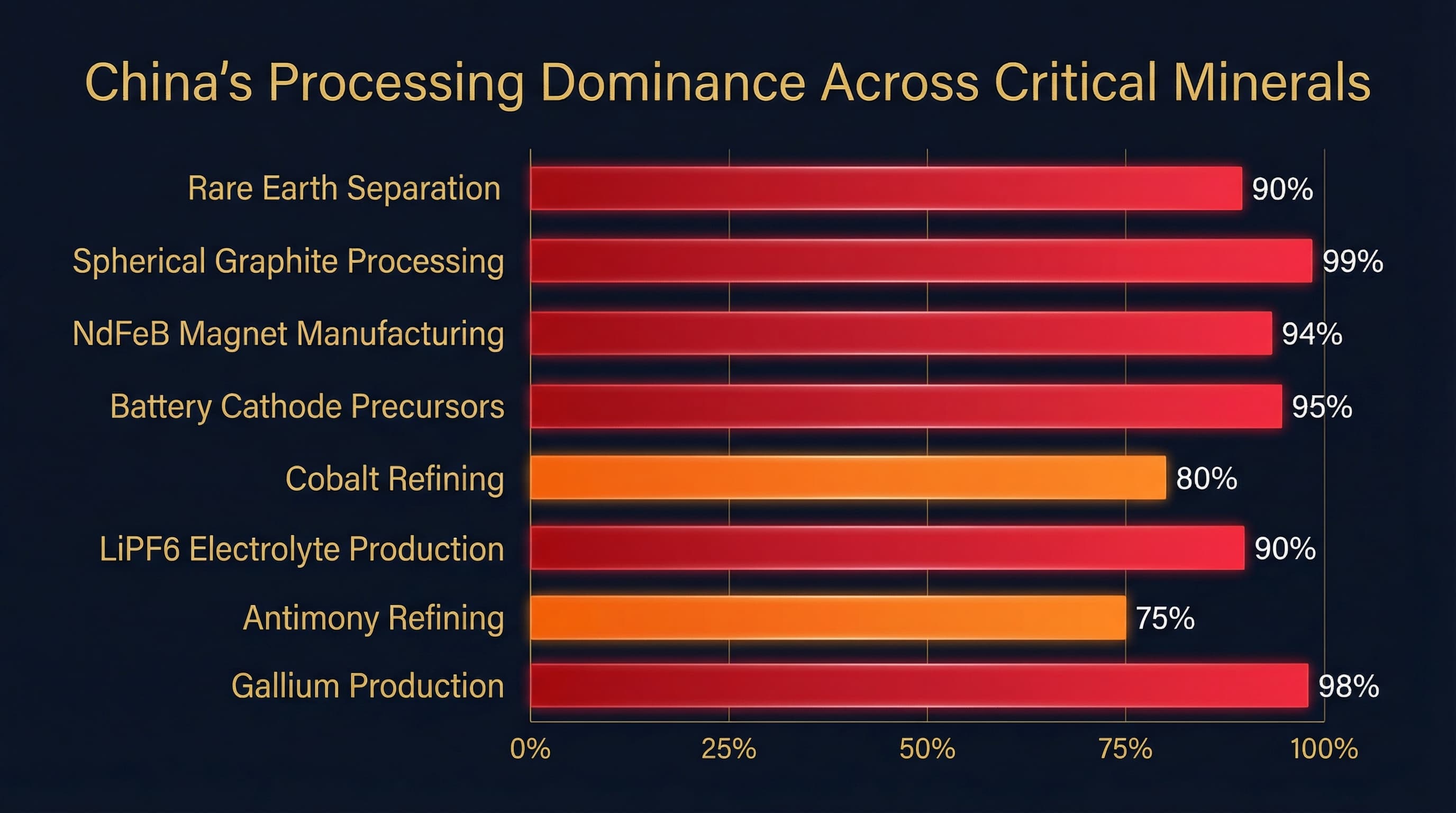
China controls 90% of rare earth separation, 99% of spherical graphite production, 93% of permanent magnet manufacturing, and 95%+ of battery cathode precursors. The real chokepoint is not extraction but the opaque, capital-intensive, environmentally brutal middle of the supply chain where raw ore becomes usable material.
This asymmetry, compounded by a 30-year knowledge gap, hostile permitting regimes, and patient Chinese state capital versus quarterly-return-obsessed Western finance, means that even optimistic timelines for supply chain resilience extend beyond 2030. The implications span from an F-35 program dependent on 920 pounds of rare earths per aircraft to an electric vehicle transition requiring minerals that flow overwhelmingly through Chinese refineries.
Key Takeaways
- Processing dominance: China controls 90% rare earth separation, 99% spherical graphite, 94% NdFeB magnets, 95%+ cathode precursors
- Defense vulnerability: F-35 requires 920 lbs rare earths; Virginia-class sub needs 9,200 lbs; no viable Western alternatives exist
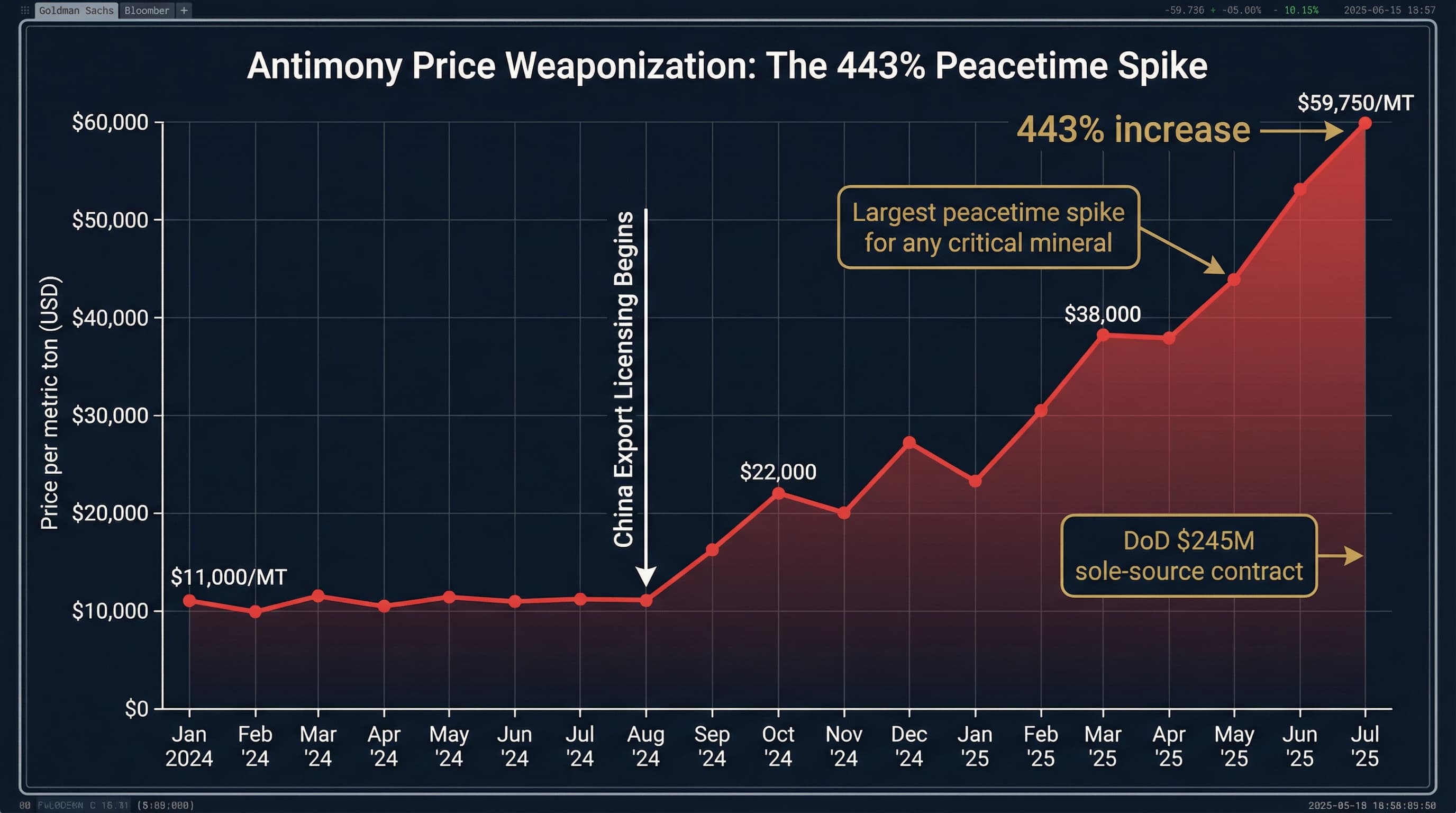
- Antimony weaponization: 443% price spike from $11,000/MT to $59,750/MT following Chinese export controls
- Myanmar risk: 57-60% of China's rare earth imports from conflict zones; supplies 66% of global heavy rare earths (dysprosium, terbium)
- Timeline reality: Western processing capacity trails by decade; realistic resilience not before 2030
- Hidden dependencies: LiPF6 electrolyte salt 90%+ Chinese; hydrogen fluoride constraints; 4.5-micron copper foil trade secrets
The Fundamental Misunderstanding
The fundamental misunderstanding in Western critical minerals strategy is treating mining as the vulnerable link. It is not. Consider rare earth elements: the United States produces approximately 45,000 metric tons annually at MP Materials' Mountain Pass mine, 12% of global output, yet until April 2025, the vast majority was shipped to China for separation and processing. Australia's Lynas Rare Earths operates the largest non-Chinese mine at Mt Weld, but processing occurs in Malaysia. Myanmar supplies 57-60% of China's rare earth imports, including two-thirds of global heavy rare earths (dysprosium, terbium), from conflict zones controlled by ethnic armed organizations. In each case, extraction happens outside China, but the material flows into Chinese processing infrastructure.
The gap becomes starker when you examine each stage of the value chain. Rare earth processing is not a single step: it cascades through beneficiation, separation chemistry, oxide production, metal reduction, alloy production, magnet sintering, and finishing. China controls 85-91% of separation capacity, over 90% of metal production, and 94% of sintered neodymium-iron-boron magnet manufacturing. The United States' entire 2025 magnet production target is approximately 1,000 metric tons; China produces 300,000 metric tons annually. At full planned capacity, U.S. production would represent 3% of global output.
Graphite reveals an even more severe concentration. China produces 65-75% of natural graphite and processes 99% of spherical graphite, the anode material comprising 28% of lithium-ion battery weight. Syrah Resources' Balama mine in Mozambique was positioned as the primary non-Chinese alternative until December 2024, when civil unrest forced a halt to operations, triggering loan defaults and a 93% stock collapse. The company's Louisiana processing facility, the first vertically integrated graphite anode operation outside China, remains subscale at 11,250 metric tons annually against projected 2035 demand requiring 97 new mines globally.
Battery minerals follow the same pattern. The DRC produces 70-80% of global cobalt, but Chinese state-owned enterprises control 80% of that output and Chinese refiners process 72-80% of the metal globally. Indonesia's nickel boom, with production surging 158% from 2019 to 2024, is financed by $30 billion in Chinese investment centered on the Indonesia Morowali Industrial Park, where 11 smelters and 2.6 gigawatts of coal-fired power process ore that Western companies cannot access due to Indonesia's raw ore export ban and ESG hesitancy around coal-intensive operations.
Hidden Dependencies the Mainstream Analysis Misses
The concentration extends into layers rarely examined. Battery manufacturing equipment itself is dominated by Chinese firms. Lead Intelligent Equipment and Yinghe Technology collectively hold 20-25% of the $15.6 billion global market, while companies like TOB New Energy supply turnkey production lines to Tesla, LG, and Sony. Even Western gigafactories depend on Chinese machinery.
More critically, chemical reagents create invisible chokepoints. Lithium hexafluorophosphate (LiPF6), the essential electrolyte salt in all lithium-ion batteries, is 90%+ produced in China. Manufacturing it requires hydrogen fluoride, a hazardous compound that creates severe permitting obstacles in the United States. Koura's $400 million Louisiana project, using licensed Japanese technology, will not come online until 2026. Meanwhile, Huntsman, the only U.S. producer of ultrapure ethylene carbonates used in electrolytes, paused expansion after Chinese overproduction crashed prices by 75%.
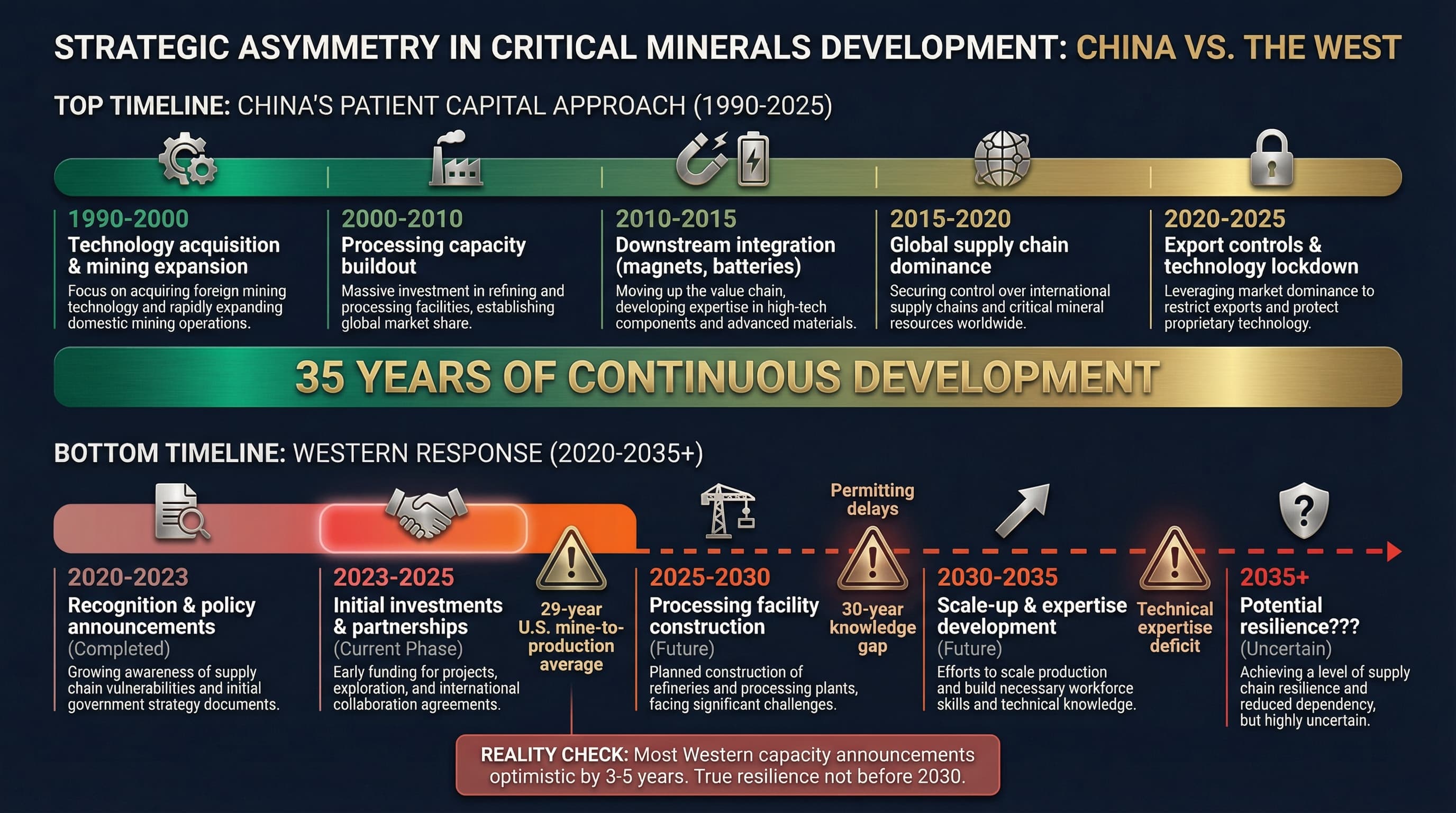
The technical knowledge gap may be the most daunting barrier. China did not inherit rare earth dominance. It engineered it over three decades while Western expertise atrophied. Solvent extraction for rare earth separation requires hundreds to thousands of processing stages, with optimal formulations representing tacit knowledge concentrated in Chinese engineers. When Western projects attempt to hire consultants, they encounter China's 2023 ban on exporting processing technology, extended in October 2025 to include equipment and components. The United States' average mine-to-production timeline of 29 years (second-longest globally) reflects not just permitting delays but the absence of institutional capability.
Financing structures amplify the asymmetry. Chinese policy banks provided $56.9 billion in loans to overseas transition mineral projects from 2000-2021 through 26 state-backed institutions. This "patient capital" offers long-term, relationship-based credit without commodity hedging requirements or quarterly return pressures. By contrast, U.S. private equity typically demands 15%+ annualized returns, incompatible with mining projects' decade-long development cycles and volatile commodity prices.
How Minerals Become Weapons Systems
Tracing minerals to end products reveals the stakes concretely. The F-35 Lightning II requires approximately 920 pounds of rare earth elements per aircraft, more than any fighter in history. Samarium-cobalt magnets (roughly 50 pounds per plane) enable operation at temperatures up to 350°C in missile nose cones and engine components where neodymium magnets would demagnetize. Lockheed Martin is the largest U.S. consumer of samarium, a metal China produces exclusively. In 2022, F-35 deliveries were suspended after Chinese-origin samarium-cobalt magnets were discovered in Honeywell turbomachinery components.
Rhenium, among the rarest elements on Earth, constitutes 6% of single-crystal superalloys in turbine blades for the F-22 and F-35, enabling operation above 2,000°F. Global production totals only 40-50 metric tons annually; 80% goes to jet engines. The U.S. maintains no government stockpile, and China's aerospace industry is stockpiling aggressively, doubling prices in 2024.
Naval platforms require even larger mineral quantities. A Virginia-class submarine contains 9,200 pounds of rare earth elements for quiet electric propulsion, sonar transducers, and degaussing systems. An Arleigh Burke destroyer requires 5,200 pounds. The Navy's AN/SPY-6 radar systems depend on gallium nitride semiconductors, a material for which China controls 98% of primary production and imposed complete export bans to the United States in December 2024.
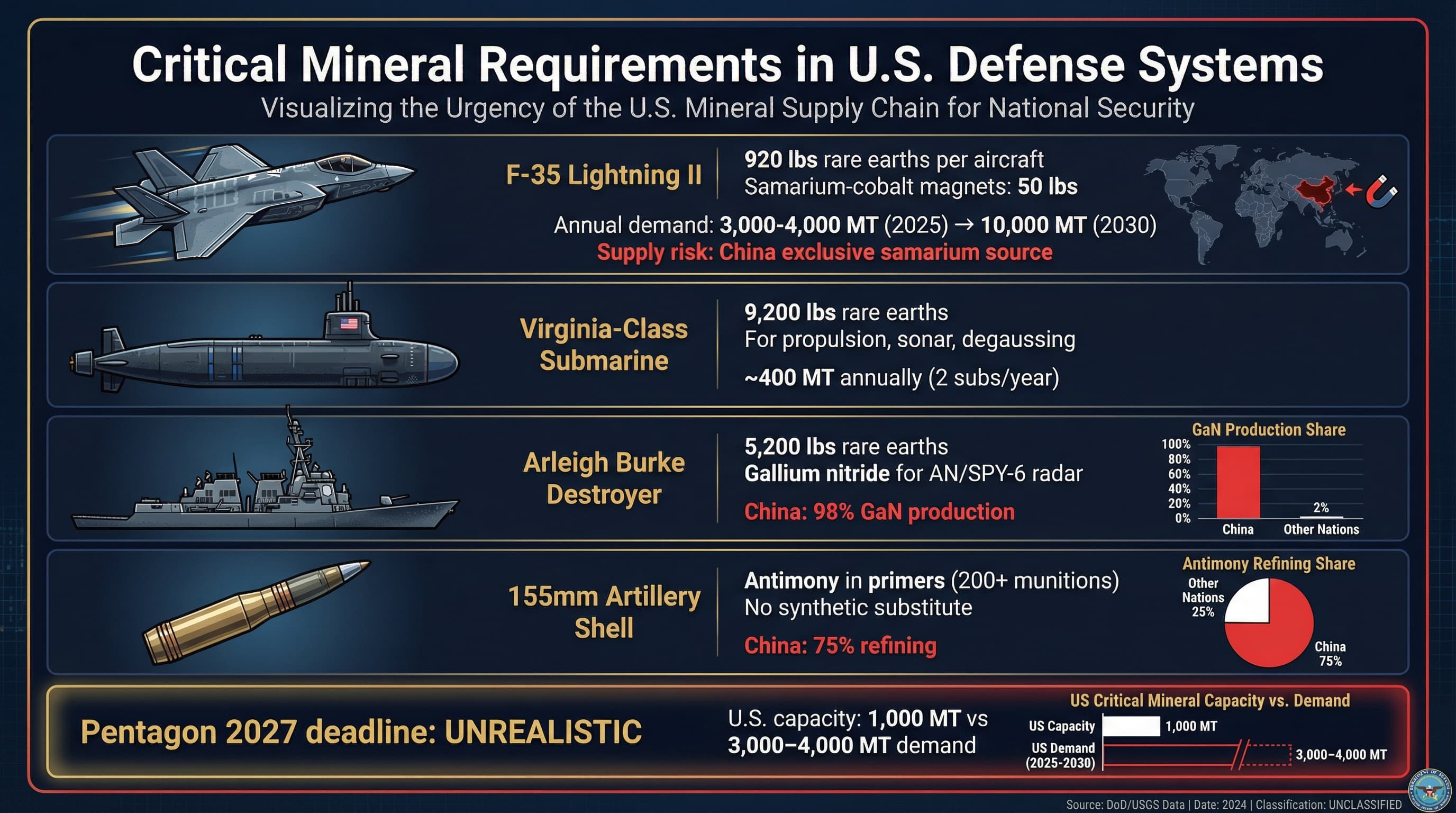
The munitions industrial base faces acute vulnerability. Antimony is used in over 200 Department of Defense munitions from 5.56mm rounds to 155mm artillery shells, primarily in lead stibnum primers for which no synthetic substitute exists. China controls 48% of mining and 75%+ of global refining. Following August 2024 export licensing requirements, antimony prices spiked from $11,000/MT in January 2024 to $59,750/MT by July 2025, a 443% increase representing the largest peacetime price spike for any critical mineral in recorded history. The Pentagon awarded a $245 million sole-source contract to the only integrated North American smelter, US Antimony Corp's Montana facility, explicitly acknowledging no alternatives exist.
Geopolitics Mapped Against Mineral Geography
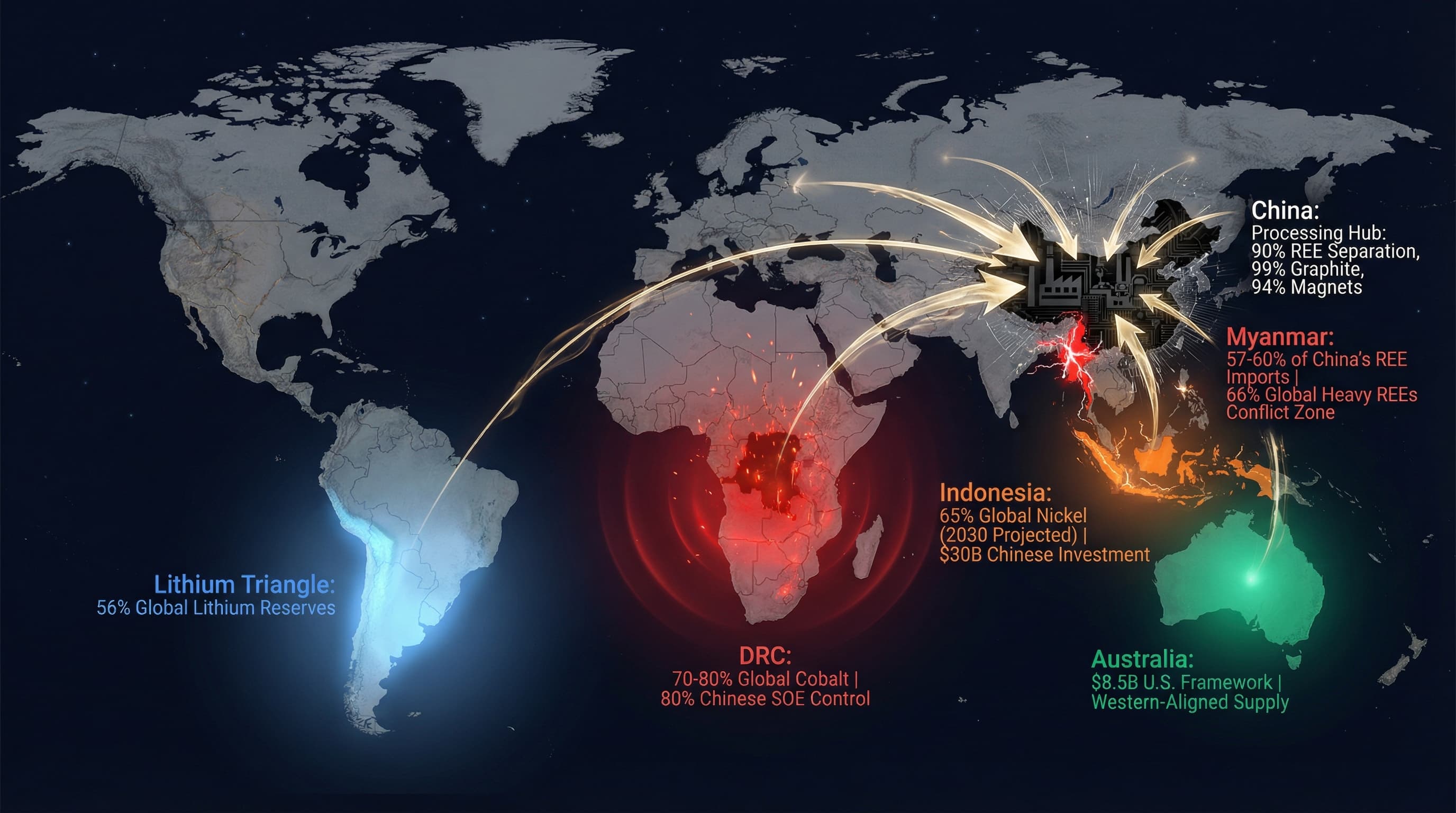
Resource geography creates distinct spheres of competition. The DRC's Katanga copper belt, containing nine of ten largest cobalt mines, is effectively Chinese territory: half of industrial mines are Chinese-owned, 60 of 75 processing plants are operated by Chinese nationals, and China Molybdenum's combined operations at Tenke Fungurume and Kisanfu produced 114,000 metric tons in 2024, representing 31% of global supply.
Indonesia's transformation into a nickel superpower, projected to supply 65% of global nickel by 2030, was engineered through a 2014 raw ore export ban that forced domestic processing, followed by massive Chinese capital infusion. The Indonesia Morowali Industrial Park alone spans 4,000 hectares with $20.93 billion invested, 43,000 workers, and 2.6 GW of coal-fired capacity. Western ESG concerns about coal dependence create openings for Chinese capital willing to ignore environmental externalities.
Myanmar represents the most precarious supply node. From 130 active rare earth mining sites in 2020 to 370+ by end-2024, the country now produces 16% of global output and supplies 57-60% of China's imports, including the heavy rare earths (dysprosium, terbium) essential for high-temperature magnets in F-35 actuators and EV motors. Mining occurs in Kachin State territory controlled by the Kachin Independence Army, which seized hub towns Chipwi and Pangwa in October 2024 from a military-aligned warlord. All processing occurs in China. Myanmar has zero domestic separation capability and no infrastructure for exporting to non-Chinese markets.
The "lithium triangle" of Chile, Argentina, and Bolivia holds 56% of global reserves but illustrates how political economy shapes supply. Chile's April 2023 nationalization strategy requires state company Codelco to hold majority stakes in new operations with royalties up to 40%. Argentina's provincial-controlled, liberal RIGI regime (30-year tax stability, 3% royalty cap) has attracted $10-20 billion in projected investment. Bolivia, holding the largest reserves at 21 million MT, has produced only 600 metric tons despite a $1 billion CATL deal, hamstrung by high magnesium-lithium ratios, political instability, and state-led development models.
Australia's alignment with Western security architecture creates the most promising alternative supply, formalized in the October 2025 $8.5 billion U.S.-Australia Critical Minerals Framework. The agreement includes price floor mechanisms to counter Chinese market manipulation, a Rapid Response Group for supply gap detection, and specific projects including the Alcoa Wagerup gallium refinery (100 tonnes/year, 10% of global supply).
The Strategic Chessboard: Who Moves Next and Why
United States: The IRA's critical minerals requirements (60% domestic/FTA content in 2025 escalating to 80% by 2027, with FEOC exclusions beginning 2024-2025) represent the most aggressive industrial policy in decades. The $7.5 billion appropriated in July 2025 for critical minerals security includes $2 billion for National Defense Stockpile expansion. However, execution challenges are severe: DoD's January 2027 deadline to eliminate Chinese rare earths from defense systems is widely viewed as unrealistic given only 1,000 MT of domestic magnet capacity against 3,000-4,000 MT annual military demand (projected to reach 10,000 MT by 2030). The Pentagon's unprecedented 15% equity stake in MP Materials ($400 million plus $150 million loan) signals willingness to become a direct industrial actor.
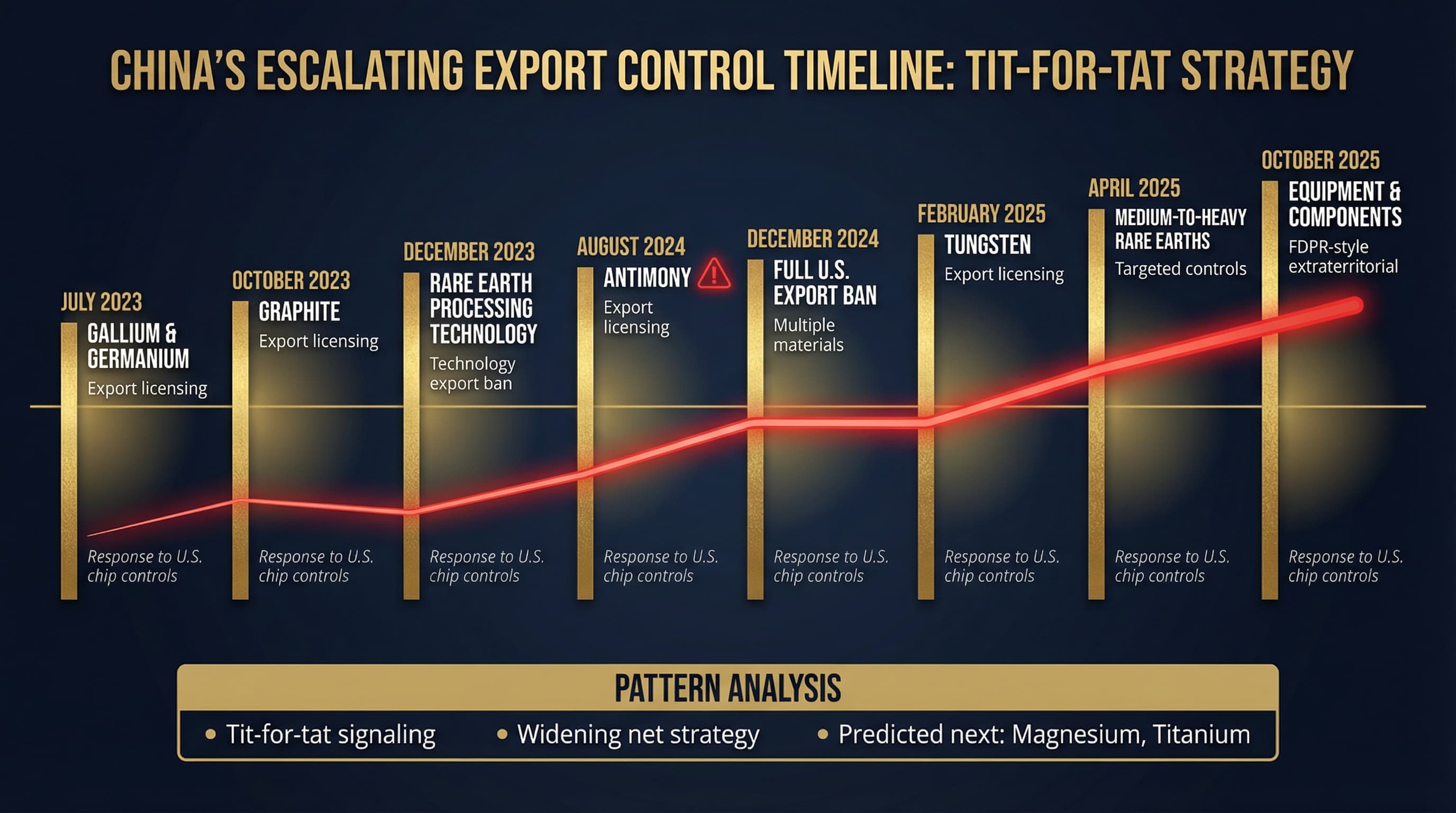
China: The dominant player's strategy is maintaining chokehold through a "widening net" of export controls. The escalation sequence (gallium/germanium licensing in July 2023, graphite in October 2023, rare earth processing technology ban in December 2023, antimony in August 2024, full U.S. export ban in December 2024, tungsten in February 2025, medium-to-heavy rare earths in April 2025, and equipment/technology in October 2025) demonstrates calibrated leverage. Each action followed U.S. semiconductor export controls, creating tit-for-tat signaling. October 2025's extension to products made with Chinese technology abroad, a FDPR-style extraterritorial approach, could affect global supply chains even if raw materials diversify. Likely next moves include controls on magnesium (85% Chinese production, no U.S. stockpile) and titanium, plus aggressive stockpiling.
Europe: The Critical Raw Materials Act (May 2024) sets ambitious 2030 benchmarks: 10% EU extraction, 40% processing, 25% recycling, maximum 65% from any single country. Current trajectories will miss these targets by years. The collapse of Northvolt (Chapter 11, November 2024; Swedish bankruptcy, March 2025) after raising €15 billion exemplifies execution risk.
Middle powers: Japan's JOGMEC model ($600 million invested in 100+ projects since 2004 with 60-180 day stockpile targets for 34 rare metals) represents the most sophisticated state-backed approach. The October 2025 U.S.-Japan framework formalizes technology transfer (Japanese separation expertise to North American facilities) and joint investments.
Where Capital Flows and What It Signals
Investment patterns reveal strategic priorities. Indonesia's nickel sector absorbed $30 billion in Chinese capital, four times the U.S.-Australia framework's total value, demonstrating willingness to accept environmental externalities Western investors avoid. BRI-linked mining loans reached $24.9 billion in H1 2025 alone, a record pace. Meanwhile, lithium's 75-80% price crash from 2022 peaks to ~$15/kg has made Western projects uneconomical without government support, exactly as Chinese oversupply intended.
The Africa race is accelerating. By 2029, eight African mines are projected to supply 9% of global rare earth supply (up from <1% in 2020). Shenghe Resources' acquisition of Tanzania's Peak Rare Earths illustrates Chinese strategy: secure assets before they become strategic.
Recycling represents a paradox. Less than 1% of rare earths are currently recycled globally despite theoretical potential, because Chinese virgin material prices make secondary supply uneconomical. Redwood Materials (16% market share, 95% recovery rates), Li-Cycle ($475 million DOE loan), and Umicore lead battery recycling, but the transformative EV battery recycling wave will not arrive until the 2030s when current-generation vehicles reach end-of-life (15 million tonnes by 2030 by Li-Cycle estimates).
The Non-Obvious Connections Others Miss
Several dependencies reveal themselves only through integrated analysis:
The aluminum-gallium nexus: Gallium is a byproduct of aluminum refining. The decline of the U.S. aluminum industry (production ceased at the only primary smelter in 2022) eliminated domestic gallium recovery potential. Rebuilding requires aluminum refining capacity, not standalone gallium projects.
The hydrogen fluoride constraint: Manufacturing LiPF6 electrolyte salt requires hydrogen fluoride, a hazardous compound that has caused injuries and deaths. Western permitting regimes make HF-intensive processes nearly impossible, creating an invisible ceiling on battery supply chain repatriation.
The 4.5-micron trade secret: Ultra-thin battery copper foil (reduced from 20µm to 4.5-6µm for higher energy density) requires proprietary additive formulations concentrated in Chinese manufacturers. Even "Western" batteries use Chinese current collectors, separators, and precursors assembled on Chinese equipment.
The heavy rare earth void: The most acute vulnerability is dysprosium and terbium, essential for high-temperature magnet performance in F-35 actuators, EV motors, and offshore wind turbines. Myanmar supplies 60%+ of Chinese imports; no credible Western alternative exists. Energy Fuels' White Mesa Mill produced its first kilogram of 99.9% purity dysprosium oxide in August 2025. Commercial scale will not arrive until Q4 2026, with capacity of only 48 MT/year against demand measured in thousands of metric tons.
The permitting paradox: Processing rare earths generates radioactive thorium waste requiring NRC licensing and $50-100 million in facility upgrades for OECD-compliant operations. China's Bayan Obo and Myanmar's conflict-zone mines operate without such constraints. Western environmental standards are simultaneously essential values and competitive disadvantages.
What Rationality Demands and Reality Constrains
A rational actor with perfect information would immediately recognize that processing capacity, not mining diversification, determines strategic autonomy. Yet the United States has prioritized mining partnerships while processing capacity trails by a decade. The October 2025 MP Materials heavy rare earth separation facility targets only 200 MT/year of dysprosium and terbium, against military demand alone measured in tonnes.
The most vulnerable node, Myanmar's conflict-zone heavy rare earth supply, has no viable Western solution. Trump administration proposals to engage the Kachin Independence Army face legal constraints (18 U.S.C. § 2339A material support statutes, sanctions on the military regime). India's December 2024 visit to Kachin State explored alternatives but lacks infrastructure and precedent.
Timelines consistently overstate progress. Most Western capacity announcements are optimistic by 3-5 years. Mining projects require 7-15 years from discovery to production; processing facilities take 3-5 years with permitting. The GAO estimates 15 years to overhaul defense supply chains. The DoD's January 2027 deadline to eliminate Chinese materials from weapon systems will require waivers.
The path forward demands accepting uncomfortable trade-offs: engaging Indonesia's coal-intensive nickel despite ESG concerns, because it is the only scaled alternative; building strategic stockpiles despite budget constraints; establishing price floor mechanisms to counter Chinese market manipulation; and accepting that meaningful supply chain resilience will not arrive before 2030 under any realistic scenario.
China spent three decades building comprehensive control while the West outsourced industrial capacity for quarterly returns. Reversing that asymmetry requires not mining announcements but the patient, unglamorous work of building separation facilities, training chemical engineers, reforming permitting regimes, and deploying state capital on timelines measured in decades. The mineral chokehold can be broken, but not on Silicon Valley timelines.
Conclusion: The Decade That Determines the Century
The critical minerals landscape has entered a period of structural competition that will shape great power rivalry through mid-century. China's position, controlling 90% of rare earth processing, 99% of spherical graphite, 93% of permanent magnets, and 95%+ of cathode precursors, represents the kind of strategic leverage that resources-as-weapons theorists have long anticipated.
The non-obvious insight is that the real competition is not for minerals but for the industrial ecosystems that transform them: the separation facilities, the equipment manufacturers, the chemical supply chains, the trained engineers, the patient capital structures. China's ban on exporting processing technology (2023, expanded 2025) reveals awareness that this capability, not raw ore, constitutes strategic advantage.
For defense planners, the implication is that near-term weapon system production remains hostage to supply chains passing through adversary territory. The F-35 program, Virginia-class submarines, and precision-guided munitions depend on materials China can restrict. For clean energy strategists, the implication is that decarbonization pathways run through Chinese processing facilities regardless of where batteries are assembled. For investors, the implication is that mining projects without integrated processing are incomplete bets on supply chains others control.
The minerals that power modern civilization (in jet engines and EV motors, wind turbines and semiconductors, munitions and consumer electronics) have become instruments of statecraft. The nation that controls their transformation from ore to finished material controls chokepoints that neither markets nor diplomacy can easily circumvent.
Our Perspective
At The Proteus Group, we approach critical minerals investments through a geopolitical risk lens that most financial advisors lack. Our principals have direct experience navigating resource nationalism, export controls, and supply chain vulnerabilities across emerging markets. We understand that mining equity is not exposure to commodity prices but to processing capacity, regulatory arbitrage, and state capital competition.
For institutional investors seeking strategic minerals exposure, we emphasize three non-consensus positions: (1) Processing assets in allied jurisdictions matter more than mining stakes in resource-rich but politically volatile regions. (2) The 2025-2030 window creates asymmetric opportunities in Western processing buildouts that will be competed away once supply chains stabilize. (3) Recycling infrastructure investments are chronically undervalued given the certainty of EV battery end-of-life volumes post-2030.
If you are evaluating critical minerals exposure, defense supply chain implications, or industrial policy investment opportunities, we would welcome the conversation. Contact us to discuss how strategic minerals fit within portfolio construction amid great power competition.
Sources & References
- U.S. Geological Survey (2025). "Mineral Commodity Summaries 2025"
- International Energy Agency (2024). "Critical Minerals Market Review 2024"
- U.S. Government Accountability Office (2024). "Rare Earth Elements: DOD Supply Chain Analysis"
- Center for Strategic and International Studies (2024). "China's Critical Minerals Strategy"
- Congressional Research Service (2025). "Defense Industrial Base: Critical Minerals Dependencies"
- Benchmark Mineral Intelligence (2025). "Lithium Ion Battery Market Database"
- Roskill Information Services (2025). "Rare Earths Market Outlook to 2035"
- World Bank (2024). "Minerals for Climate Action: The Mineral Intensity of the Clean Energy Transition"
- McKinsey & Company (2024). "The Raw Materials Challenge: How the Metals and Mining Sector Will Be at the Core of Enabling the Energy Transition"
- S&P Global (2025). "Critical Minerals Pricing and Supply Database"