
The Fundamental Question: Structure as Strategy
The global trust and estate planning industry generates over $20 billion annually in legal, fiduciary, and administrative fees. This scale reflects both the genuine complexity of multigenerational wealth transfer and a troubling reality: many structures are sold, not bought.
The difference matters. Structures that are sold tend to optimize for fee generation, regulatory arbitrage, and perceived sophistication. Structures that are bought solve specific, articulated problems that the family has identified through careful analysis.
I have reviewed dozens of trust structures over the past decade. The pattern is unmistakable: the most effective structures were designed backward, from a clear understanding of what problems needed solving to the legal architecture that solves them. The least effective were designed forward, from available products to families who could be persuaded to use them.
This analysis provides the backward framework: start with the strategic question, work toward the structural answer.
Key Takeaways
- Structure follows strategy: Define the specific problems you are solving before selecting any legal architecture. Asset protection, succession planning, and tax efficiency require different structures
- The four genuine use cases: Trusts and estates create measurable value in asset protection, governance enforcement, cross-border succession, and concentrated position management. Tax deferral alone rarely justifies the costs
- Jurisdiction selection is overrated: The difference between top-tier jurisdictions is marginal compared to the quality of documentation, governance, and ongoing administration
- African entrepreneur considerations: Currency risk, political instability, and succession law conflicts create unique structuring requirements that developed market templates do not address
- The 15-year test: If your structure does not create clear, measurable value over a 15-year horizon when compared to simpler alternatives, you have the wrong structure
When Estates and Trusts Create Genuine Value
The trust structure originated in medieval England, where crusaders needed mechanisms to manage property during extended absences. Eight centuries later, the core function remains unchanged: separating legal ownership from beneficial enjoyment to achieve objectives impossible under direct ownership.
But the question is not whether trusts can create value. The question is whether they create value in your specific situation that justifies the costs, complexity, and constraints.
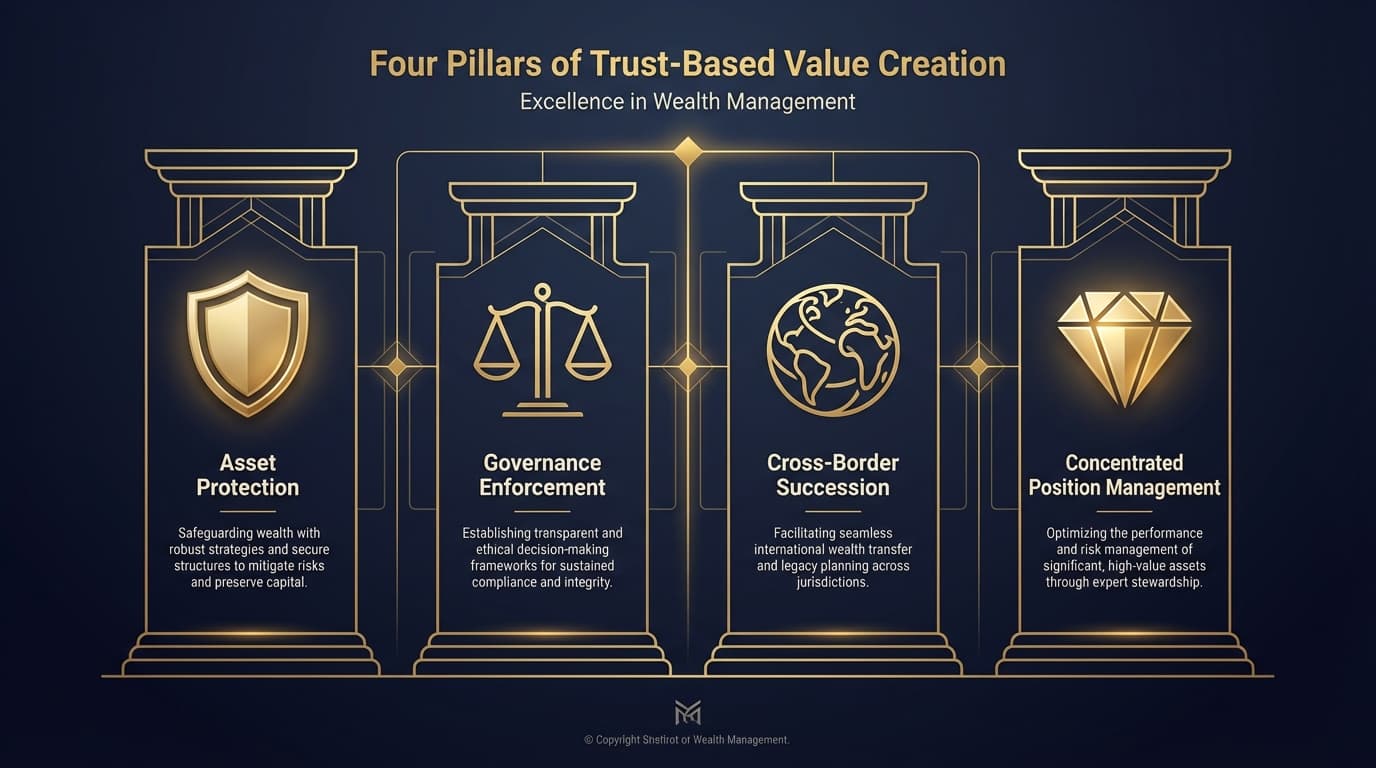
The Four Legitimate Use Cases
Strategic Value Creation Framework:
| Use Case | Core Problem Solved | Value Creation Mechanism | Typical Beneficiaries |
|---|---|---|---|
| Asset protection | Creditor claims, litigation exposure, political risk | Legal separation of ownership from beneficial interest | Entrepreneurs, professionals, politically exposed persons |
| Governance enforcement | Successor incapacity, family conflict, value dilution | Binding rules that survive the original wealth creator | Families with complex dynamics, multi-branch structures |
| Cross-border succession | Conflicting inheritance laws, forced heirship regimes | Trust law supersedes local succession rules | Families with assets or heirs in multiple jurisdictions |
| Concentrated position management | Liquidity constraints, diversification needs, founder control | Tax-efficient transition mechanics, staged diversification | Founders with illiquid holdings, pre-IPO shareholders |
Each use case has a clear diagnostic: if you cannot articulate which of these problems you are solving, you likely do not need a trust.
Use Case 1: Asset Protection
Asset protection is the most frequently cited, and most frequently oversold, rationale for trust structures. The genuine case is narrower than promoters suggest.
When Asset Protection Creates Value:
True asset protection value exists when:
- You face genuine, quantifiable litigation exposure (medical professionals, corporate directors, politically exposed individuals)
- Your wealth exceeds the coverage limits of available insurance products
- You operate in jurisdictions with unpredictable legal systems or political risk
- Your business model creates tail risk that insurance cannot adequately price
When Asset Protection Is Illusory:
Asset protection structures fail or underperform when:
- They are established after creditor claims arise (fraudulent conveyance)
- The settlor retains too much control (alter ego doctrine)
- The jurisdiction has reciprocal enforcement with creditor jurisdictions
- Ongoing compliance and administration is neglected
The Asset Protection Spectrum:
| Structure | Protection Level | Key Limitation | Typical Annual Cost |
|---|---|---|---|
| Domestic revocable trust | Minimal | Subject to domestic court orders | $2,000-5,000 |
| Domestic irrevocable trust | Moderate | Transferor liability periods apply | $5,000-15,000 |
| Self-settled domestic asset protection trust | Moderate-High | Only 20 US states, limited track record | $8,000-20,000 |
| Offshore irrevocable trust | High | Requires genuine offshore nexus, ongoing costs | $15,000-50,000+ |
| Private Trust Company structure | Very High | Significant setup costs, ongoing governance | $50,000-150,000+ |
The analysis shows a clear cost-benefit tradeoff. For most families, the incremental protection from moving up this spectrum does not justify the incremental costs. But for those with genuine exposure, particularly politically exposed Africans with assets in unstable jurisdictions, the calculus changes dramatically.
Use Case 2: Governance Enforcement
The most underappreciated value of trust structures is their ability to enforce governance across generations and family branches. This is not about tax or asset protection. It is about making sure wealth survives the humans who created it.
The Governance Problem:
Research consistently shows that 70% of wealth transitions fail by the second generation, and 90% by the third. The primary causes are not economic. They are governance failures:
- Lack of preparation for heirs
- Communication breakdowns between generations
- Absence of shared family purpose
- Conflict over control and distributions
How Trusts Solve Governance:
A properly designed trust creates binding rules that:
- Define who can access capital and under what conditions
- Establish standards for trustee selection and removal
- Create incentive structures for beneficiary behavior
- Preserve flexibility through protector roles and trust committees
Governance Framework Comparison:
| Governance Mechanism | Enforceability | Flexibility | Typical Application |
|---|---|---|---|
| Verbal family understanding | None | Complete | Never recommended |
| Family constitution (non-binding) | Moral only | High | Complementary to legal structures |
| Will with testamentary trust | High post-death | Low post-death | Single generation, simple situations |
| Inter vivos irrevocable trust | Very high | Moderate (via protector) | Multi-generational, complex families |
| Private Trust Company | Very high | High (via governance documents) | Large families, dynasty planning |
The key insight: governance value increases with family complexity. A single heir with good judgment needs minimal governance. A multi-branch family spanning continents with varied financial sophistication needs substantial governance architecture.
Use Case 3: Cross-Border Succession
When family members, assets, or both span multiple jurisdictions, direct ownership creates succession nightmares. Different countries have different rules for:
- Forced heirship (mandatory inheritance shares for spouses and children)
- Community property (automatic spousal claims to assets)
- Probate procedures (often lengthy, expensive, and public)
- Estate taxation (with rates varying from 0% to 55%)
The Cross-Border Complexity Matrix:
| Jurisdiction | Forced Heirship | Estate Tax | Probate Required | Trust Recognition |
|---|---|---|---|---|
| United Kingdom | No | 40% above threshold | Yes | Full |
| France | Yes (50-75% to children) | Up to 45% | Yes | Limited |
| United Arab Emirates | Yes (Sharia law default) | 0% | Yes | DIFC/ADGM only |
| United States | No (except Louisiana) | 40% above threshold | Yes | Full |
| Nigeria | Yes (customary law varies) | 0% (currently) | Yes | Limited |
| South Africa | No | 25% above threshold | Yes | Full |
| Singapore | No | 0% | Yes | Full |
| Switzerland | Yes (varies by canton) | Varies by canton | Yes | Full |
Why Trusts Solve Cross-Border Succession:
Properly structured trusts bypass local succession laws because the trust, not the individual, owns the assets. Upon death, there is no "succession" of the assets; they remain in the trust with new beneficial interests arising per the trust deed.
This creates genuine, measurable value:
- Avoidance of multiple probate proceedings
- Override of forced heirship rules (in most cases)
- Simplified succession across jurisdictions
- Privacy (trusts are not public record in most jurisdictions)
- Speed (no waiting for probate courts)
Use Case 4: Concentrated Position Management
Entrepreneurs and executives with significant concentrated holdings face a specific challenge: how to diversify and achieve liquidity without triggering immediate tax consequences and loss of control.
The Concentrated Position Dilemma:
| Option | Tax Efficiency | Liquidity | Control Retention | Complexity |
|---|---|---|---|---|
| Direct sale | Poor (immediate tax) | High | None | Low |
| Charitable remainder trust | Good | Moderate | Limited | Moderate |
| Grantor retained annuity trust | Excellent | Delayed | Limited | High |
| Intentionally defective grantor trust | Excellent | Transferred | Limited | High |
| Exchange fund | Good | Delayed | None | Moderate |
| Private placement life insurance | Excellent | Delayed | Moderate | High |
For founders with $10 million or more in illiquid concentrated holdings, the tax efficiency and control benefits of structured solutions typically justify the complexity. Below this threshold, the math often favors simplicity.
When Estates and Trusts Do Not Create Value
Understanding when structures are inappropriate is as important as knowing when they add value.
The Oversold Scenarios
I've seen families spend hundreds of thousands on structures that solved problems they didn't have. Here are the scenarios where trusts consistently disappoint:
Pure tax deferral focus. Tax laws change, and they change frequently. The structure that deferred gains in 2020 may face punitive treatment by 2030. Meanwhile, compliance costs compound annually, and exit strategies often trigger the very taxes you deferred. For most families, disciplined tax-efficient direct investing outperforms elaborate deferral schemes.
Small estates under $3 million. The arithmetic is unforgiving. When annual administration costs run $10,000-30,000, a $2 million estate bleeds 0.5-1.5% annually before any investment returns. A simple will and direct ownership preserves far more wealth.
Single jurisdiction, simple succession. If your assets are in one country, your heirs live there, and your succession wishes are straightforward, you're paying for complexity you don't need. Basic testamentary planning handles this efficiently.
Speculative asset protection. Establishing a trust because you might face litigation someday invites fraudulent transfer challenges and alter ego attacks. Courts look dimly on structures created without genuine purpose. Proper insurance and liability management provide more reliable protection for speculative risks.
Keeping up with peers. "My business partner has a Jersey trust" is not a structuring rationale. If you cannot articulate the specific problem being solved, you're likely buying sophistication for its own sake.
Advisor revenue generation. Some structures are sold because they're profitable to the advisors, not because they serve family interests. If the recommendation comes primarily from someone who earns fees from implementation, seek a second opinion from a fee-only advisor with no stake in the outcome.
The Cost-Benefit Test
Before establishing any structure, quantify:
Structure Cost Analysis:
| Cost Category | One-Time | Annual Ongoing | 15-Year Total |
|---|---|---|---|
| Legal establishment | $15,000-100,000 | - | $15,000-100,000 |
| Trustee/administration | - | $5,000-50,000 | $75,000-750,000 |
| Accounting/compliance | - | $3,000-20,000 | $45,000-300,000 |
| Investment management | - | 0.5-1.0% of assets | Varies by AUM |
| Opportunity cost of complexity | Hard to quantify | Hard to quantify | Significant |
Total 15-year cost for a $10M structure: $150,000-$1,200,000+
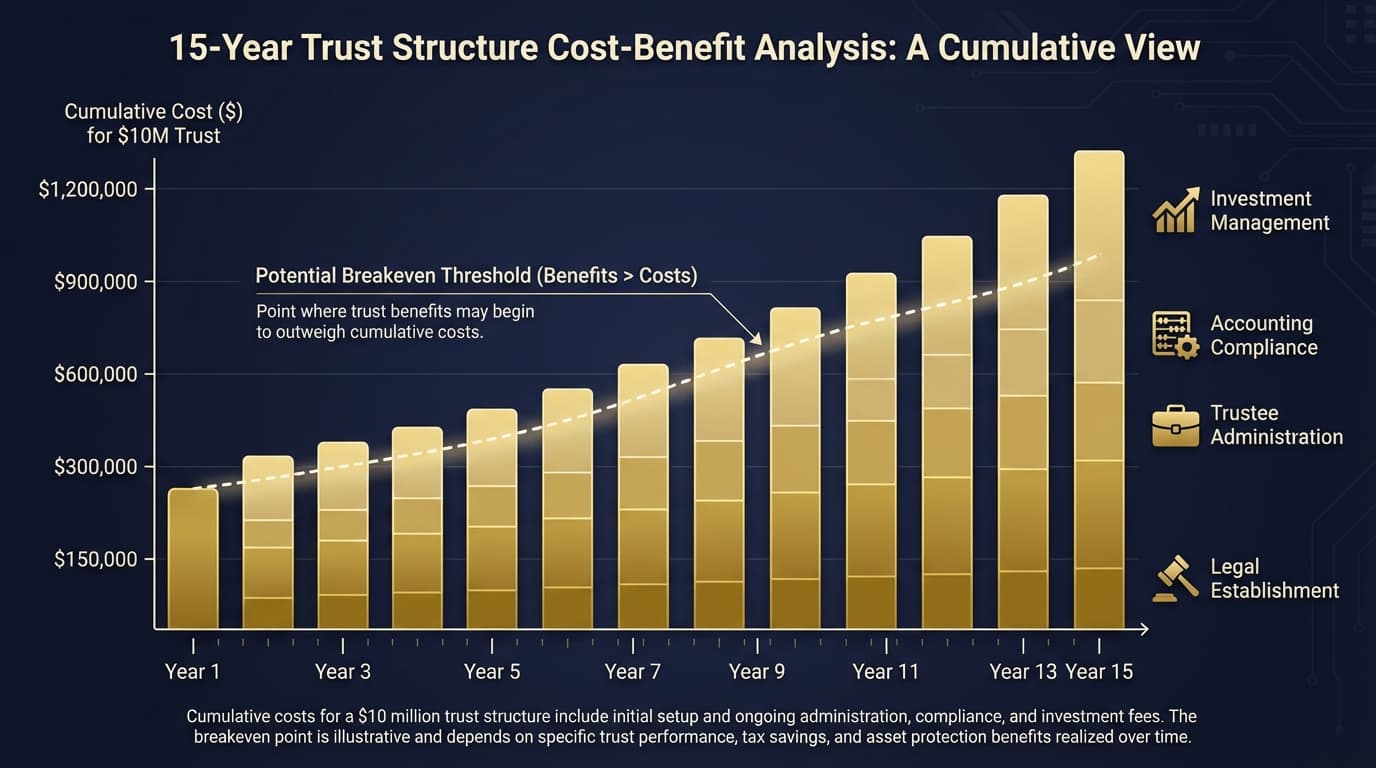
Unless the structure creates clear, quantifiable benefits exceeding these costs, simpler alternatives are superior.
Jurisdiction Selection: Separating Substance from Marketing
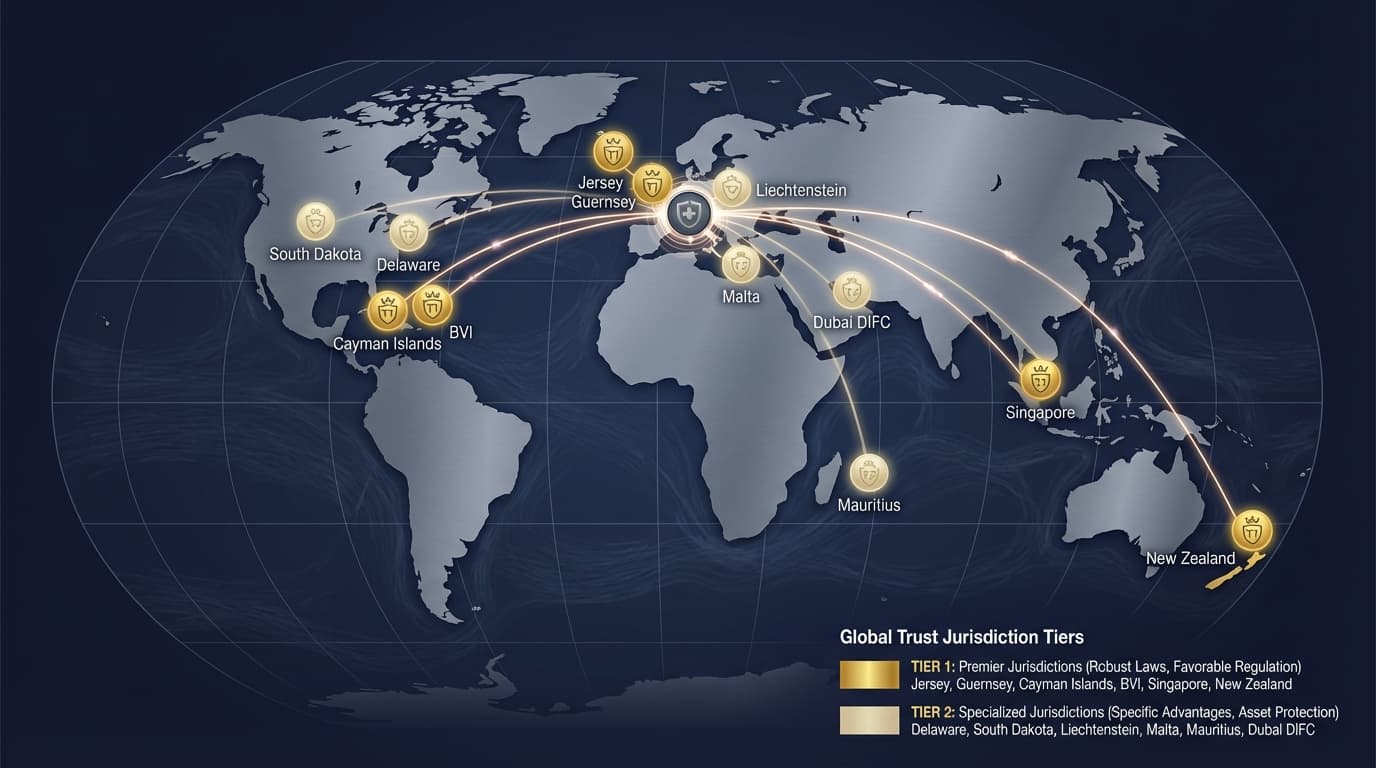
The trust industry has created a cottage industry of "ranking" jurisdictions. These rankings are largely marketing. The differences between top-tier jurisdictions are marginal compared to:
- The quality of the trust documentation
- The competence of the trustee
- The ongoing administration and compliance
- The appropriateness of the structure for your specific situation
The Jurisdiction Selection Framework
Tier 1 Jurisdictions (Broadly Equivalent):
| Jurisdiction | Key Advantages | Key Limitations | Best For |
|---|---|---|---|
| Jersey | Excellent case law, sophisticated trustees | High costs, UK political proximity | European families, institutional structures |
| Guernsey | Similar to Jersey, strong privacy | Smaller industry, less case law | Privacy-focused structures |
| Cayman Islands | No direct taxation, strong financial sector | US reporting burden (FATCA), hurricane risk | US taxpayers, fund structures |
| British Virgin Islands | Low cost, established framework | Less sophisticated trustee options | Cost-sensitive structures |
| Singapore | Asian nexus, stable governance | Shorter track record, less case law | Asian families, China-adjacent structures |
| New Zealand | Common law, stable, no estate tax | Geographic remoteness, small industry | Pacific Rim families |
Tier 2 Jurisdictions (Specialized Uses):
| Jurisdiction | Specialized Use Case | Caution |
|---|---|---|
| Delaware (US) | Directed trusts, dynasty trusts | US tax complexity |
| South Dakota (US) | Asset protection, perpetual trusts | Limited track record on asset protection |
| Liechtenstein | Foundations, civil law families | High costs, EU pressure |
| Malta | EU nexus structures | Small industry |
| Mauritius | Africa-focused structures, India treaty network | Smaller trustee pool |
| DIFC (Dubai) | Sharia law override, Middle East nexus | Limited to DIFC-registered structures |
The Jurisdiction Selection Decision Tree
- Where are your assets located? Start with jurisdictions that have favorable recognition and enforcement
- Where are your beneficiaries? Consider tax implications for beneficiary jurisdictions
- What is your primary use case? Asset protection requires different considerations than succession planning
- What is your budget? Higher-cost jurisdictions require larger structures to be cost-effective
- What is your time horizon? Dynasty planning needs jurisdictions with perpetuity or very long trust periods
African Entrepreneurs: Specific Considerations
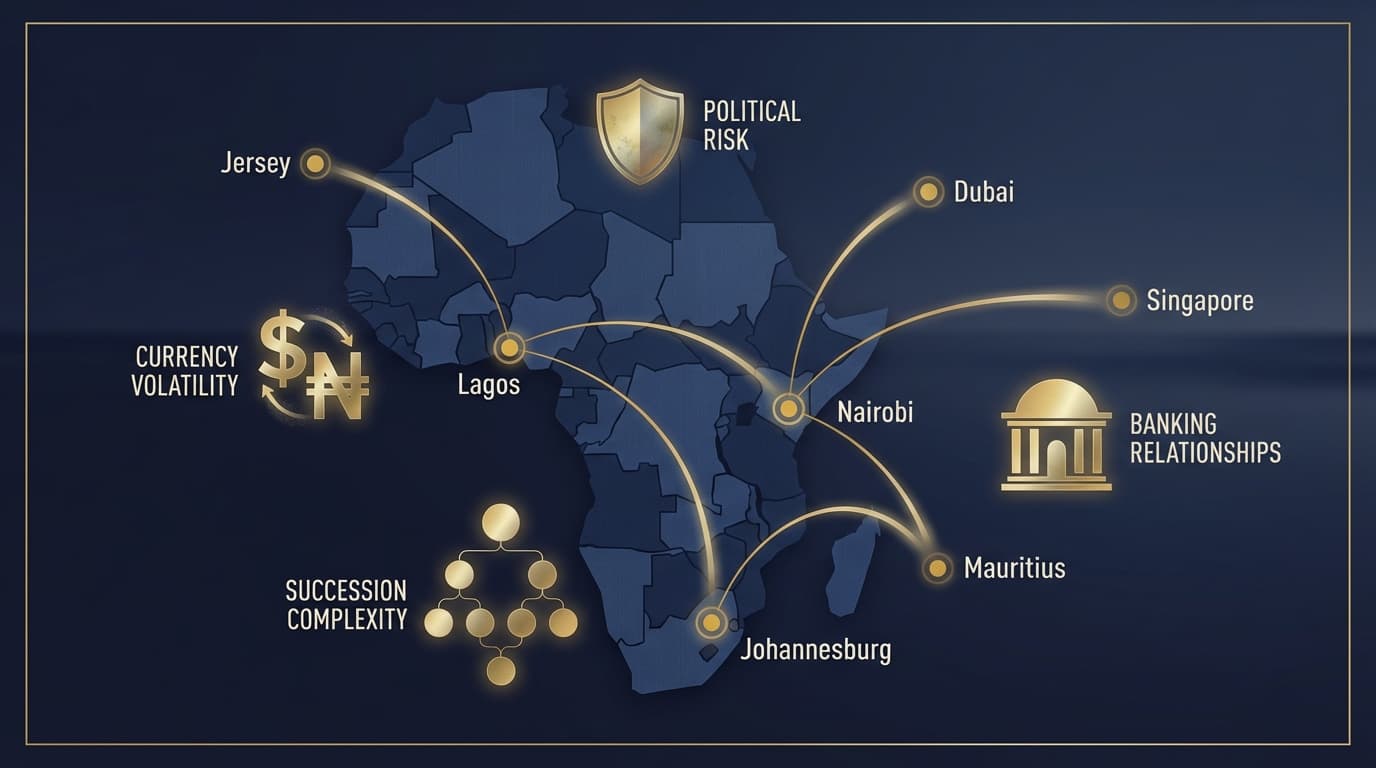
The standard estate planning literature is written for developed market families with stable currencies, reliable legal systems, and manageable political risk. African entrepreneurs face fundamentally different dynamics.
The African Wealth Creation Context
Distinctive Characteristics of African Entrepreneurial Wealth:
| Characteristic | Implication for Structuring | Common Mistake |
|---|---|---|
| Currency volatility | Hard currency denomination essential | Keeping assets in local currency "for convenience" |
| Political instability | Asset protection is defensive necessity, not optional | Assuming current stability persists |
| Informal succession norms | Legal structures must coexist with customary expectations | Ignoring traditional family dynamics |
| Concentrated business wealth | Liquidity planning critical before estate events | Assuming business can be divided or sold easily |
| Multi-jurisdictional families | Children educated abroad, spouses from different regions | Single-jurisdiction planning |
| Banking system fragility | Offshore banking relationships essential | Over-reliance on domestic banking |
Jurisdiction Considerations for African Entrepreneurs
African-Relevant Jurisdiction Analysis:
| Jurisdiction | Africa Connection | Advantages | Disadvantages |
|---|---|---|---|
| Mauritius | Geographic proximity, Africa treaties, time zone alignment | Established Africa focus, reasonable costs, India treaty network | Small trustee pool, limited case law |
| Jersey/Guernsey | Historical connections, established Africa desks | Deep expertise, strong case law, premium service | High costs, distance, time zone issues |
| Dubai (DIFC/ADGM) | Growing Africa trade, Islamic finance options | Geographic proximity, cultural familiarity, no estate tax | Limited track record, succession law complexity |
| South Africa | Regional hub, legal sophistication | Common law, geographic proximity, established profession | Political risk, exchange control, Tier 2 jurisdiction |
| UK | Colonial legal connections, familiar courts | Deep expertise, recognized globally | Estate tax exposure, costly |
| Singapore | Emerging Africa interest, neutral ground | Excellent governance, Asia access | Distance, less Africa expertise |
The Nigerian and West African Context
Nigerian entrepreneurs face specific structural challenges:
Nigeria-Specific Considerations:
- Exchange Control: Moving funds offshore requires careful compliance with CBN regulations. Structures must be established with legitimately sourced and documented capital
- Succession Law Conflicts: Nigeria has three parallel succession regimes (statutory, customary, and Islamic) that may conflict with trust provisions. Proper structuring requires explicit choice of law provisions and sometimes domestic complementary structures
- Banking Relationships: Many Nigerian banks have lost correspondent banking relationships. Offshore structures need independent banking that does not rely on Nigerian bank intermediation
- Political Exposure: Many successful Nigerian entrepreneurs have some level of political exposure, whether as elected officials, appointees, or government contractors. This creates enhanced due diligence requirements globally
- Real Property: Nigerian land cannot be held in trust due to the Land Use Act. Real property requires parallel domestic structures
Recommended Approach for Nigerian Entrepreneurs:
| Asset Type | Recommended Structure | Jurisdiction | Key Consideration |
|---|---|---|---|
| Liquid investments | Irrevocable trust | Mauritius or Jersey | Choose trustees with Nigeria experience |
| Operating businesses | Holding company under trust | BVI or Mauritius | Ring-fence operating risk from family assets |
| Real property | Domestic family company | Nigeria | Subject to Nigerian succession law |
| International property | Trust direct ownership | Per trust jurisdiction | Avoid Nigerian succession law conflicts |
| Life insurance | Trust ownership | Guernsey or Isle of Man | Ensure policy jurisdiction aligns |
The South African Context
South African residents face exchange control and offshore structuring limitations:
South Africa-Specific Considerations:
- Exchange Control: Individual foreign capital allowance of R10 million per calendar year (with tax clearance); discretionary allowance of R1 million. Emigration requires formal financial emigration process
- Trust Taxation: South African trusts are taxed at 45% flat rate on retained income. Offshore trusts with SA resident beneficiaries face attribution rules
- Controlled Foreign Company Rules: South African residents holding 10%+ in foreign companies face CFC attribution
- Estate Duty: 25% on worldwide estate above R30 million (20% on first R30 million). Trusts can defer but not eliminate
Recommended Approach for South African Entrepreneurs:
| Scenario | Recommended Structure | Key Consideration |
|---|---|---|
| Emigration planned | Offshore trust pre-emigration | Establish while still resident using allowances |
| Remaining resident | Domestic trust + offshore diversification | Accept limited offshore capacity |
| Business exit liquidity event | Offshore trust post-exit | Time structure around exit; use emigration if appropriate |
| Next generation abroad | Offshore structures for non-resident children | Beneficiary taxation may differ |
The East African Context
Kenya, Tanzania, and Uganda have varying trust law sophistication:
East Africa-Specific Considerations:
- Kenya: Reasonably developed trust law based on English common law. Nairobi has emerging family office infrastructure. Local trusts viable for local assets
- Tanzania: Limited trust infrastructure. Offshore structures recommended for significant wealth
- Uganda: Similar to Tanzania. Limited domestic capacity
- Rwanda: Emerging financial center with progressive regulations. Worth monitoring for future options
Implementation: The Decision Framework
Step 1: Problem Articulation
Before any structuring conversation, work through these diagnostic questions honestly:
Do you face genuine, quantifiable litigation or creditor risk? Not theoretical risk, but actual exposure from your profession, business activities, or political profile. If yes, asset protection structures are warranted. If this is speculative or "just in case," asset protection should not drive your structuring decisions.
Will your estate span multiple jurisdictions at death? Consider where your assets sit, where your heirs live, and where you hold citizenship or residency. If you'll trigger probate in multiple countries or face conflicting succession laws, cross-border planning is essential. If everything is in one jurisdiction with straightforward succession, domestic planning likely suffices.
Do you have concerns about heir readiness or family conflict? Be honest about whether your heirs can manage significant wealth responsibly, and whether family dynamics create conflict risk. If yes, governance structures provide genuine value. If your succession is simple and your heirs are capable, elaborate governance adds cost without benefit.
Do you hold concentrated illiquid positions above $10 million? Founders with significant stakes in private companies or pre-IPO equity face genuine structuring opportunities. Below this threshold, the complexity costs typically exceed the benefits.
Is your wealth above 10x the cost of sophisticated structuring? If your total estate is $5 million and proper structuring costs $500,000 over 15 years, you're spending 10% of your wealth on administration. Keep it simple. If your estate is $50 million, those same costs represent 1%, potentially justifiable if genuine problems are being solved.
Step 2: Structure Selection
Match the structure to the articulated problems:
Structure Selection Matrix:
| Primary Problem | Secondary Problem | Recommended Structure |
|---|---|---|
| Asset protection | Cross-border succession | Offshore irrevocable trust, asset protection jurisdiction |
| Governance | Asset protection | Offshore trust with detailed governance provisions |
| Cross-border succession | Tax efficiency | Trust in tax-neutral jurisdiction, careful beneficiary planning |
| Concentrated position | Governance | GRAT or IDGT with family governance overlay |
| All of the above | Multiple | Private Trust Company with underlying trusts |
Step 3: Jurisdiction Selection
When evaluating jurisdictions, weight your analysis appropriately:
Legal infrastructure matters most (roughly 25% of your decision). Assess the depth of trust case law, sophistication of the courts, and quality of the professional community. Jersey and Guernsey have centuries of precedent. Newer jurisdictions may offer attractive features but lack the jurisprudential depth to handle complex disputes.
Tax treatment deserves significant weight (roughly 20%). Understand how the jurisdiction taxes trust income, how beneficiary distributions are treated, and what information exchange agreements exist with relevant countries. A tax-neutral trust jurisdiction loses its appeal if your beneficiaries face punitive attribution rules.
Asset protection strength (roughly 20%) depends on fraudulent transfer lookback periods and whether the jurisdiction recognises foreign judgments. The best asset protection jurisdictions require creditors to re-litigate claims locally, a significant hurdle.
Cost considerations (roughly 15%) include establishment fees, annual trustee charges, accounting, and legal compliance. Higher-cost jurisdictions like Jersey require larger structures to be economical; a $3 million trust in Jersey often pays disproportionate fees relative to its size.
Practical factors (roughly 10%) matter more than people admit. Time zone alignment affects responsiveness. Language compatibility reduces friction. Travel accessibility becomes important when you need face-to-face meetings with trustees.
Political stability (roughly 10%) of the jurisdiction itself deserves consideration. Even offshore centres face geopolitical pressures, regulatory changes, and reputational risks that can affect your structure over a multi-decade horizon.
Step 4: Trustee Selection
The trustee choice matters more than the jurisdiction choice.
Trustee Selection Framework:
| Trustee Type | Advantages | Disadvantages | Best For |
|---|---|---|---|
| Individual (family) | Low cost, family knowledge | Mortality, potential conflict, limited expertise | Small, simple structures |
| Individual (professional) | Expertise, independence | Mortality, key person risk | Moderate structures |
| Corporate trustee (bank) | Institutional permanence, expertise | Cost, bureaucracy, staff turnover | Standard structures |
| Corporate trustee (independent) | Specialized expertise, personal service | Less permanence than banks | Complex, bespoke structures |
| Private Trust Company | Maximum control, custom governance | High cost, regulatory burden | Large family wealth ($50M+) |
Step 5: Documentation and Governance
The trust deed is not a form document. It is a governance constitution that will bind your family for generations. I've reviewed trust deeds where boilerplate language created ambiguity that cost families hundreds of thousands in legal fees to resolve. Get the documentation right.
Start with a clear statement of purpose. This guides trustee discretion when the deed is silent on specific situations. The most common failure is accepting boilerplate language that sounds legal but provides no genuine guidance on family intent. What do you actually want this trust to accomplish? Write that down in plain language.
Define beneficiaries precisely but flexibly. Overly narrow definitions exclude future needs you cannot anticipate (a grandchild with special needs, a beneficiary who needs capital for a legitimate business opportunity). Overly broad definitions provide no guidance and invite disputes. Strike the balance by defining classes clearly while preserving discretion for genuinely unforeseen circumstances.
Distribution standards require family-specific thinking. The standard "health, education, maintenance, and support" (HEMS) language tells a trustee almost nothing. What does "support" mean for your family? Is maintaining a beneficiary's lifestyle at age 25 the same standard as age 45? Provide real guidance.
Trustee powers must enable effective action without creating unchecked authority. Too restrictive and the trustee cannot respond to changing circumstances. Too unlimited and you've created governance risk. Define the powers with specificity, particularly around investments, distributions, and amendments.
Protector provisions require careful design. The protector role provides oversight and the ability to remove underperforming trustees, but a protector with power to control defeats the asset protection purpose entirely. Separate oversight from control.
Amendment and termination clauses must balance flexibility with purpose preservation. Too rigid and the trust cannot adapt to changed circumstances. Too flexible and you've undermined the governance structure entirely.
Governing law and forum selection determines which jurisdiction's laws apply and where disputes are resolved. A mismatch between your trust jurisdiction and the location of major assets creates enforcement complexity.
The Long View: Structure as Legacy Architecture
The most successful multigenerational wealth structures share common characteristics:
Characteristics of Enduring Structures:
- Clear articulation of family values and purpose beyond wealth preservation
- Governance mechanisms that evolve with family complexity
- Education and preparation of successive generations
- Flexibility to adapt to changed circumstances without betraying core purpose
- Professional support that serves the family interest, not professional fee generation
The structure itself is not the legacy. The structure is the architecture that enables the legacy. Get the architecture right, and the legacy has a chance. Get it wrong, and sophisticated planning accelerates rather than prevents wealth dissipation.
Sources & References:
- The Williams Group. "Preparing Heirs: Five Steps to a Successful Transition of Family Wealth and Values." Robert D. Reed Publishers, 2010
- STEP (Society of Trust and Estate Practitioners). "Global Trust and Estate Guide." Annual Publication
- Hughes, James E. "Family Wealth: Keeping It in the Family." Bloomberg Press, 2004
- Withers LLP. "Global Private Client: Trends and Developments." Annual Survey
- Knight Frank. "The Wealth Report." Annual Publication
- OECD. "Common Reporting Standard Implementation Handbook."
- FATF. "Guidance on Beneficial Ownership and Transparency." 2023
- Deloitte. "Family Office Survey: Global Perspectives." Annual Survey
- Credit Suisse Research Institute. "Global Wealth Report." Annual Publication
- African Private Equity and Venture Capital Association (AVCA). "Private Equity and Venture Capital in Africa." Annual Report