
Introduction: More Than a Logo on a Building
Let me be direct about something the industry rarely admits: most branded residence failures happen not because the brand was wrong, but because developers fundamentally misunderstood what they were buying.
I have watched sophisticated real estate operators treat brand licensing as a marketing expense, something to justify a price increase. They negotiate hard on licensing fees, skimp on operational standards, and then wonder why their project struggles against a Ritz-Carlton or Four Seasons development down the street. The premium buyers pay is not for a logo. It is for a promise, and when that promise is broken at any point in the ownership experience, the entire value proposition collapses.
The branded residence sector has grown 170% over the past decade. According to Savills' 2025/26 Branded Residences Report, the global market is expected to reach 910 schemes by year-end 2025, up 19% from 764 in December 2024. By 2032, contracted projects will push the total to 1,747 schemes. This is not a trend. It is a structural shift in how ultra-high-net-worth individuals think about real estate ownership.
But the headline growth numbers obscure a more nuanced reality: the gap between successful and unsuccessful branded developments is widening. The best projects sell out before launch. The worst sit half-empty, their brand partnerships quietly dissolved after contractual minimum standards prove impossible to maintain.
This analysis examines what actually drives the branded residence phenomenon, why the economics work for buyers, developers, and brands alike, and what contract structures separate the projects that deliver from those that disappoint.
Key Takeaways
- Market scale: 910 branded residence schemes globally by end-2025, projected to reach 1,747 by 2032
- Price premium: 20-35% average premium over comparable non-branded properties, up to 60% in prime locations
- Psychological driver: Trust and risk mitigation in unfamiliar markets, not status signalling
- Developer economics: 15-25% faster sell-through, 20-40% higher per-square-foot pricing, reduced marketing spend
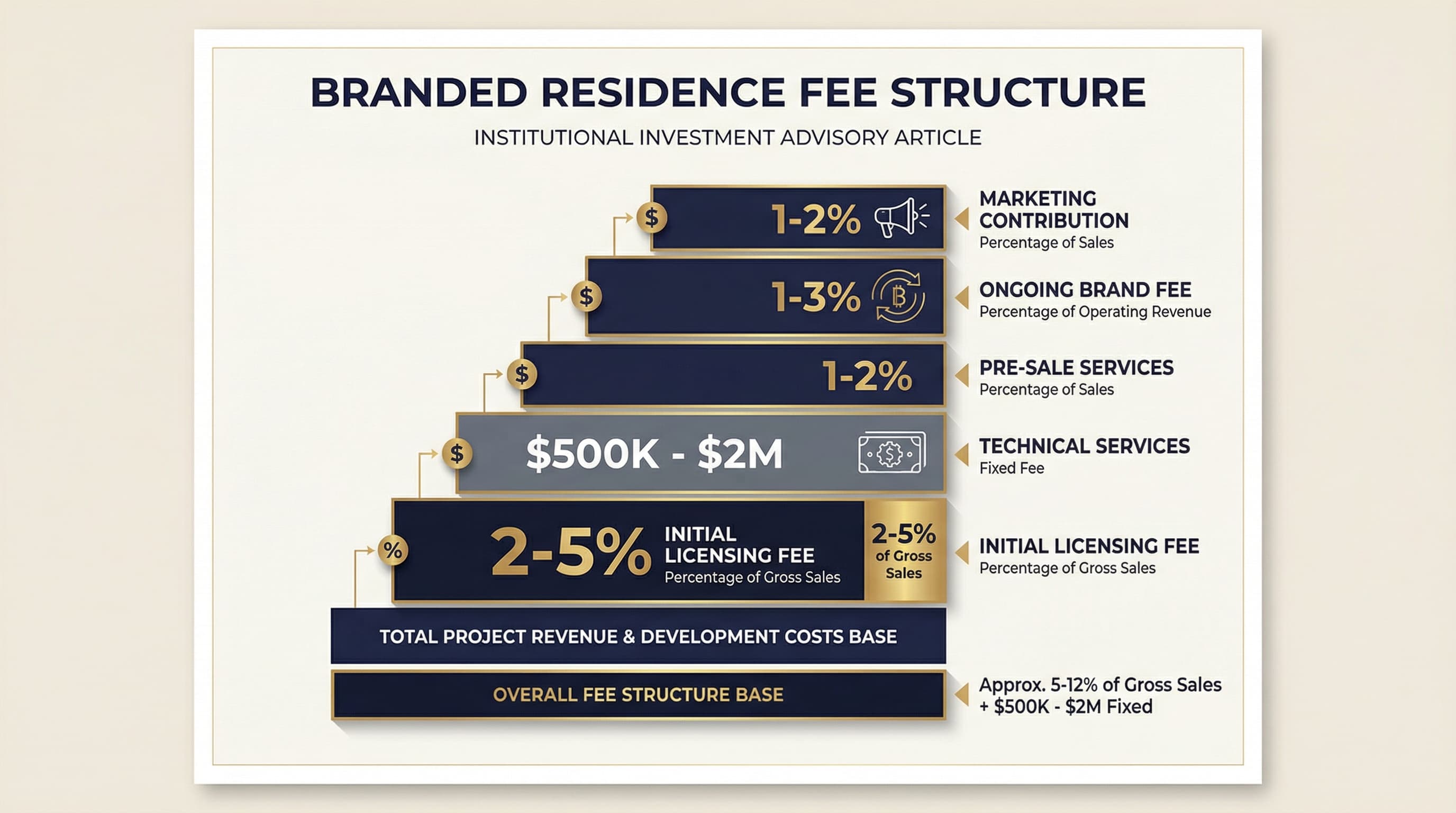
- Brand economics: Licensing fees of 2-5% of gross sales revenue plus ongoing service fees of 1-3% of operating revenue
- Contract structure: Typical agreements run 20-50 years with strict quality standards, termination rights, and operational requirements
The Psychology: Why Buyers Pay 35% More for a Brand Name
The conventional explanation for branded residence premiums centres on status. Wealthy buyers want to signal their success through association with prestigious names. This explanation is incomplete, and fundamentally misunderstands how the ultra-wealthy actually make purchasing decisions.
Trust in Unfamiliar Territory
The primary psychological driver is not status but trust. When a buyer from Singapore purchases a residence in London, or a Saudi family acquires property in Miami, they face a fundamental information asymmetry. They cannot easily verify construction quality, management competence, or resale potential. Local knowledge that domestic buyers take for granted is simply unavailable to international purchasers.
A Four Seasons or Aman affiliation solves this problem. The buyer is not paying for prestige. They are paying for a guarantee, implicit but powerful, that the development will meet standards they already understand from their hotel experiences. Research from Knight Frank indicates that branded residences in emerging markets can command premiums of up to 45%, compared to 25-35% in mature markets like London and New York. This gap reflects not greater status consciousness in emerging markets, but greater information asymmetry that brands help resolve.
The Operational Certainty Premium
Consider what a branded residence actually delivers beyond the purchase:
Predictable quality. When you buy a Ritz-Carlton residence, you know what the common areas will look like, how staff will behave, what maintenance standards will apply. This predictability has genuine economic value for buyers who will not be present to manage their property.
Management competence. Luxury property management is difficult. Finding, training, and retaining staff who can maintain five-star standards is a specialised skill that most individual owners cannot replicate. Branded residences outsource this challenge to operators who have solved it thousands of times.
Rental income potential. Many branded residences can be placed into hotel rental programmes when owners are absent. The brand's distribution system, loyalty programmes, and rate management create revenue streams that unbranded properties cannot access.
Exit certainty. When it comes time to sell, buyers face less friction. The next purchaser understands what they are buying without extensive due diligence. This liquidity premium is particularly valuable in markets where property transactions are slow or complex.
Identity Alignment, Not Status Display
The psychological research on luxury consumption has evolved significantly. A 2022 study published in Frontiers in Psychology found that luxury purchases increasingly reflect identity alignment rather than status signalling. Buyers ask not "Will this impress others?" but "Does this reflect who I am?"
For branded residence buyers, this manifests as brand loyalty transfer. Someone who stays at Aman properties, who understands the design philosophy and service ethos, experiences genuine affinity with the brand. Purchasing an Aman residence is not about displaying wealth. It is about extending a lifestyle choice into permanent real estate ownership.
This distinction matters for developers and brands selecting partners. The most successful branded developments match buyers' existing brand relationships. A development attached to a brand the target demographic has never experienced will underperform one that resonates with established loyalty.
The Economics: Why the Numbers Work for Everyone
Branded residences succeed because they create genuine value for all three parties: buyers, developers, and brands. Understanding these interlocking economics explains why the sector continues to grow despite premium pricing.
Buyer Economics: The Premium That Pays for Itself
The 20-35% price premium for branded residences appears to destroy value for buyers. But the calculation is more nuanced.
Resale value retention. Knight Frank's research indicates that branded residences retain value better through market cycles. During the 2020-2021 period, branded properties in Dubai showed 15-20% less price volatility than comparable non-branded luxury units. This downside protection has genuine portfolio value.
Rental yield enhancement. For buyers who rent their properties, brand affiliation typically increases achievable rates by 20-30%. A Mandarin Oriental residence commands rates that a comparable unbranded apartment cannot achieve, regardless of identical physical specifications. Over a typical holding period, this yield enhancement can offset a significant portion of the acquisition premium.
Reduced operating friction. Self-managing a luxury property in a foreign market is expensive and time-consuming. Professional management through branded programmes eliminates this burden. When calculated on a risk-adjusted basis, including the cost of management errors that brands prevent, the premium becomes more defensible.
Global pricing benchmark. Branded residences provide a reference point for valuations. A Four Seasons residence in any global market trades within a predictable band relative to other Four Seasons properties. This transparency reduces transaction costs and makes financing easier to obtain.
Developer Economics: Faster Sales at Higher Prices
For developers, branded residence partnerships transform project economics in measurable ways.
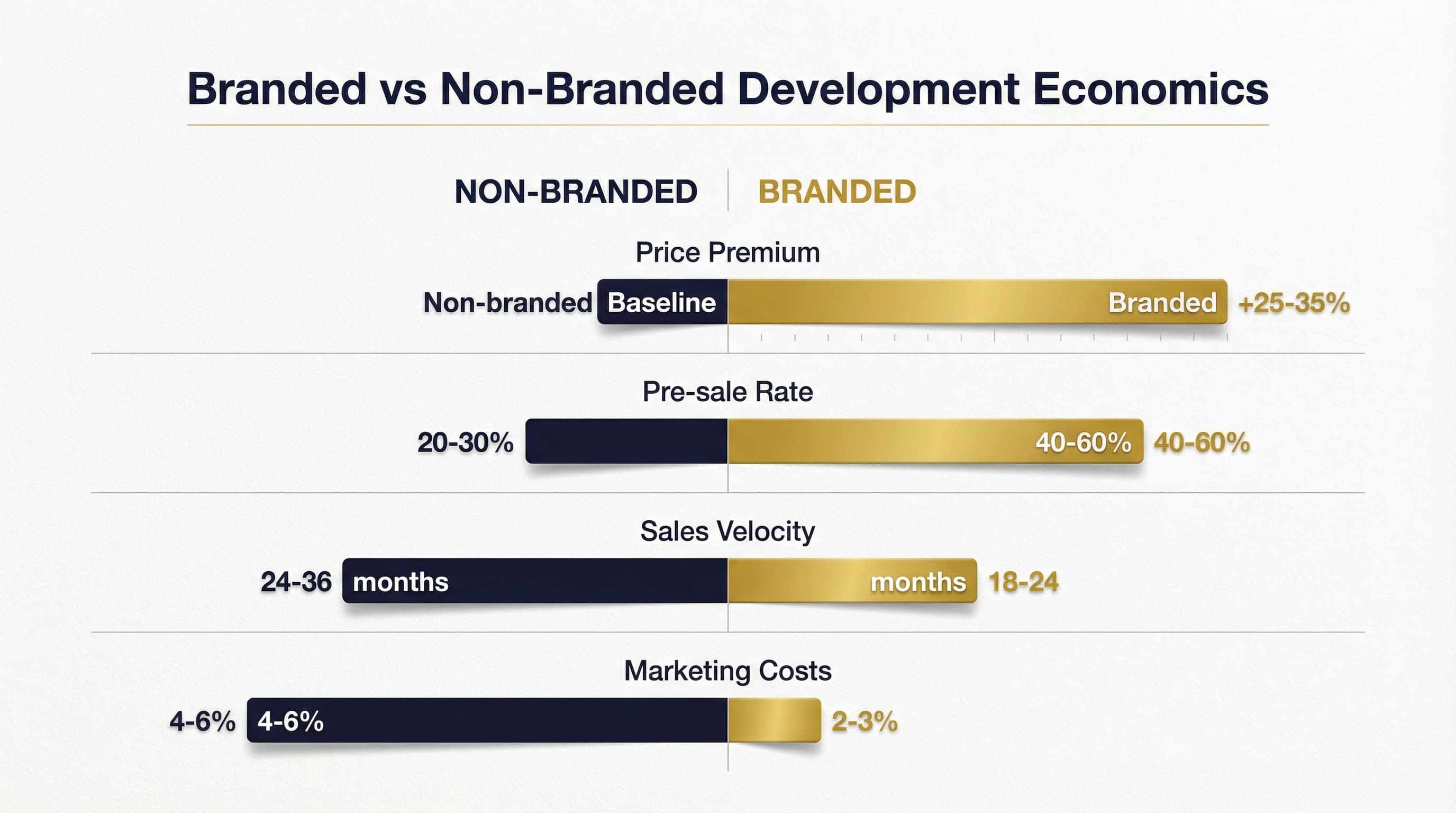
Accelerated sell-through. Industry data suggests branded projects achieve 15-25% faster sales velocity than comparable non-branded developments. In markets like Dubai and Miami, premium branded projects regularly achieve 30-50% pre-sales before public launch. This acceleration reduces carrying costs and construction financing expenses.
Per-square-foot premium. The 20-35% price premium flows directly to developer margins. On a $200 million development, a 25% premium represents $50 million in additional revenue against incremental costs that typically run 5-10% of the premium captured.
Reduced marketing spend. Branded developments benefit from the brand's existing recognition and customer database. Marketing costs as a percentage of sales typically run 2-3% for branded projects versus 4-6% for comparable non-branded developments.
De-risking construction financing. Lenders view branded projects more favourably. The combination of pre-sales velocity and brand operational commitments reduces perceived risk, translating to better financing terms. Construction loan spreads on branded projects typically run 25-75 basis points tighter than non-branded equivalents.
Brand Development Premium Analysis:
| Metric | Non-Branded Luxury | Branded Development | Advantage |
|---|---|---|---|
| Average PSF (Miami) | $1,200-1,500 | $1,500-2,000 | +25-33% |
| Pre-sale percentage | 20-30% | 40-60% | +20-30pp |
| Sales velocity (months) | 24-36 | 18-24 | 25-33% faster |
| Marketing cost (% of sales) | 4-6% | 2-3% | 50% reduction |
| Construction financing spread | SOFR + 350-400 | SOFR + 275-325 | 50-75bp savings |
Source: Savills, Knight Frank, JLL Global Branded Residences Reports 2025
Brand Economics: Recurring Revenue Without Capital Risk
For hospitality and lifestyle brands, residences represent a capital-light expansion strategy with attractive economics.
Upfront licensing fees. Brands typically charge 2-5% of gross residential sales revenue as an initial licensing fee. On a $300 million project, this represents $6-15 million in revenue with minimal marginal cost.
Ongoing service fees. Most agreements include ongoing fees of 1-3% of operating revenue or residential assessments, creating a recurring revenue stream that persists for the life of the development.
Marketing programme contributions. Developers typically contribute 1-2% of sales to brand marketing programmes, funding customer acquisition that benefits the entire brand ecosystem.
Zero capital requirement. Unlike owned hotels, branded residences require no capital investment from brands. Revenue is pure margin against existing brand infrastructure.
Global footprint expansion. Residences extend brand presence into markets where owned or managed hotels may not be feasible. This expands loyalty programme reach and creates feeder demand for hotel properties.
The mathematics are compelling. A major hospitality brand managing a portfolio of 50 branded residence projects, each averaging $200 million in sales, generates $200-500 million in licensing revenue. Ongoing service fees across 20,000+ sold units can exceed $50 million annually. This recurring revenue trades at premium multiples in brand company valuations.
Contract Structures: Where Deals Succeed or Fail
The legal architecture of branded residence agreements determines whether projects deliver on their premium promise. These contracts are complex, typically running 100+ pages with extensive schedules and exhibits. Understanding the key structural elements separates sophisticated developers from those who discover problems only after construction begins.
The Core Agreement Framework
Most branded residence deals involve three to five interconnected agreements:
1. License Agreement. The foundational contract granting rights to use the brand name, trademarks, and associated intellectual property. This agreement specifies permitted uses, geographic exclusivity, and quality standards the development must meet.
2. Technical Services Agreement. Governs the brand's involvement in design and construction. Brands typically provide design standards, review architectural plans, and approve materials and finishes. This agreement specifies the review process, approval rights, and consequences of deviation from standards.
3. Pre-Sale Services Agreement. Covers the brand's participation in marketing and sales. Defines brand involvement in sales centre design, marketing materials, buyer communications, and sales training.
4. Residential Management Agreement. Governs ongoing operations after completion. Specifies service standards, staffing requirements, and the relationship between the residence association and brand operator.
5. Hotel Management Agreement. When residences are attached to a branded hotel, this separate agreement governs hotel operations and defines the relationship between hotel and residential components.
Key Contract Terms That Determine Success
Term length and renewal. Typical agreements run 20-50 years for the initial term. Brands prefer longer terms that ensure quality control. Developers want shorter terms with renewal options to preserve flexibility. The tension resolves differently depending on negotiating leverage. A first-time developer partnering with Four Seasons has little leverage. An established developer with multiple successful projects can negotiate more favourable terms.
Quality standards and brand approval rights. This is where agreements are won or lost. Brands specify design standards, material requirements, and service levels in extensive detail. Approval rights give brands effective veto over design decisions. Developers who underestimate the operational implications of these requirements find themselves caught between brand demands and budget constraints.
A typical quality standards schedule might specify:
- Minimum unit sizes (often 20-30% larger than market standard)
- Specific appliance brands and models
- Finishing material grades and suppliers
- Common area design elements and artwork
- Staff-to-unit ratios for building services
- Response time standards for service requests
Fee structures. Standard fee components include:
| Fee Type | Typical Range | Basis | Payment Timing |
|---|---|---|---|
| Initial licensing fee | 2-5% | Gross residential sales | At closing |
| Technical services fee | $500K-2M | Fixed or per-unit | During development |
| Pre-sale services fee | 1-2% | Gross sales | During sales period |
| Ongoing brand fee | 1-3% | Residential operating revenue | Monthly/quarterly |
| Marketing contribution | 1-2% | Gross sales | During sales period |
Source: Goodwin Procter, Hogan Lovells Branded Residence Analysis 2025
Termination rights. Both parties need clear exit paths. Developers can typically terminate if construction financing fails or sales fall below specified thresholds. Brands can terminate for quality standard violations, reputational damage, or developer financial distress. The consequences of termination, including residual branding rights, transition obligations, and fee settlements, require careful negotiation.
Residential rental programme structure. For projects allowing owner rental through hotel systems, the programme terms are critical. Key issues include:
- Revenue split between owner and operator (typically 50-60% to owner after programme costs)
- Booking priority between hotel inventory and residential units
- Minimum availability requirements
- Maintenance and housekeeping standards during rental periods
- Owner blackout periods
Association governance. The relationship between the brand operator and residential owners' association requires clear definition. Key questions include:
- Who controls the association board?
- What services must be purchased from the brand operator?
- How are service levels modified over time?
- What happens if owners want to change operators?
The War Stories: What Goes Wrong
Quality standard creep. I have seen deals collapse when developers realised mid-construction that brand-required finishes exceeded budget by 20%. The brand's position was simple: meet the standards or face termination. The developer's options were limited to completion at a loss or walking away from sunk costs.
Operational cost surprises. Branded residence service levels require staffing ratios that many developers fail to model accurately. A major Middle East project discovered that maintaining brand-required services cost three times what comparable non-branded buildings spent on operations. Owners faced special assessments that created legal disputes lasting years.
Rental programme disappointments. Buyers who purchased expecting substantial rental income found that hotel operators prioritised hotel inventory, that rental programme fees consumed most of gross revenue, and that their units sat empty during peak periods. The brand was technically compliant with agreements. Buyer expectations were simply unrealistic.
Termination disputes. When a European branded residence failed to meet sales targets, the brand exercised termination rights. The developer had already sold 60 units with brand affiliation. Transitioning to a new brand, or to unbranded operation, required renegotiating with every existing purchaser. Some demanded refunds. Others sued. The legal fees exceeded the original licensing costs.
What Sophisticated Developers Negotiate
Quality standard specificity. Rather than general brand standard references, successful developers negotiate specific, enumerated standards at signing. This prevents brands from imposing new requirements mid-project.
Fee caps and floors. Percentage-based fees create alignment but also uncertainty. Sophisticated developers negotiate minimum and maximum fee amounts to bound their exposure.
Cure periods. Before brands can terminate for quality violations, developers should have meaningful cure periods, typically 30-90 days for operational issues, longer for physical plant deficiencies.
Purchaser approval requirements. Brands want approval rights over buyers to maintain community quality. Developers need to ensure these rights cannot be used to delay or block sales. Deemed approval after specified review periods protects against brand non-responsiveness.
Transition assistance. If the agreement terminates, brands should be required to assist with transition, including temporary service continuation, staff transition support, and cooperation with successor operators.
Market Dynamics: Where Branded Residences Thrive
The geographic distribution of branded residences reveals where the product resonates most strongly. Understanding these patterns helps both investors evaluating opportunities and developers selecting markets.
Current Market Distribution
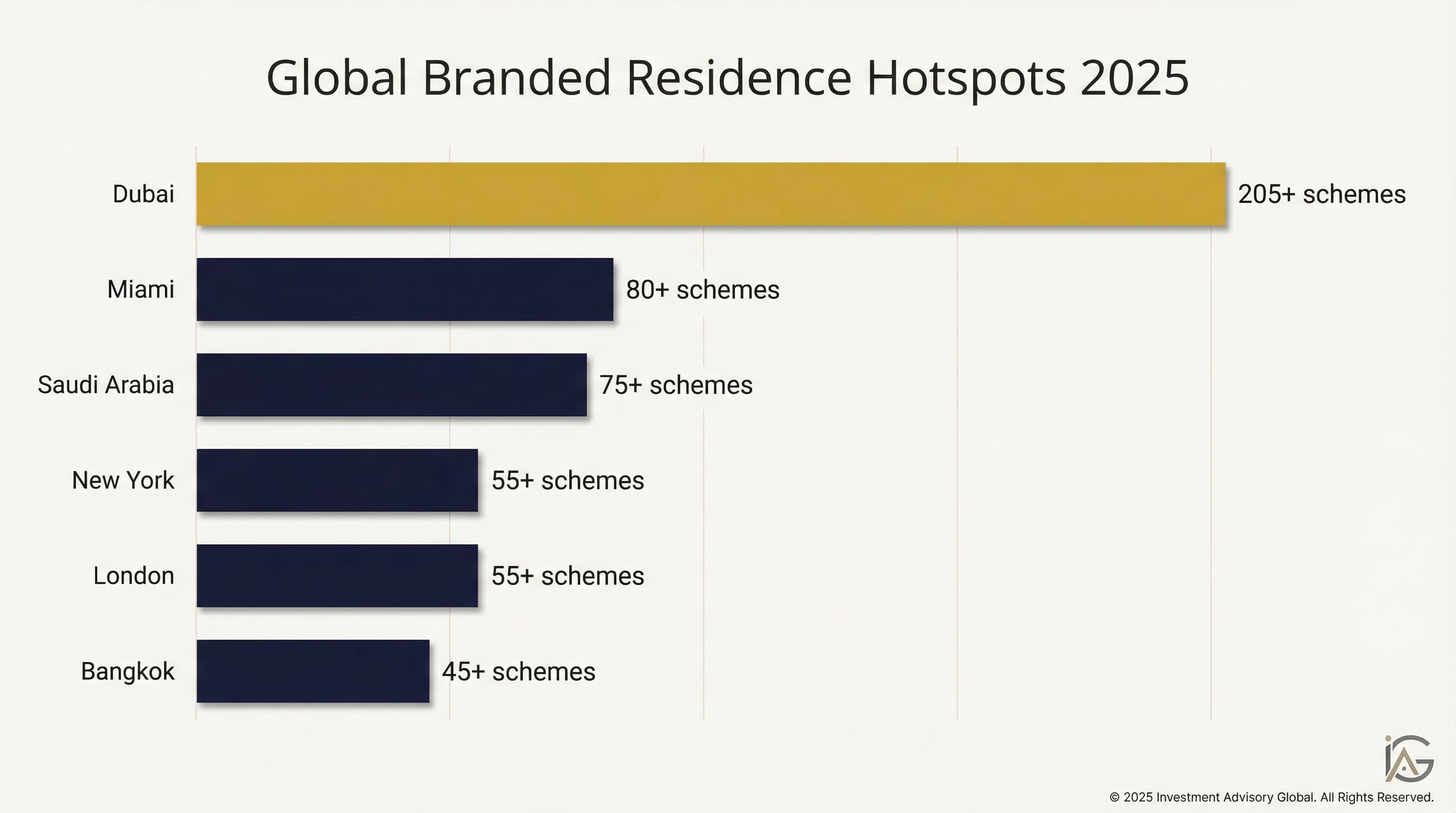
Top Markets by Branded Residence Supply (2025):
| Market | Completed Schemes | Pipeline | Total | Key Brands |
|---|---|---|---|---|
| Dubai, UAE | 85+ | 120+ | 205+ | Armani, Bulgari, Four Seasons, Dorchester |
| Miami, USA | 45+ | 35+ | 80+ | Ritz-Carlton, Four Seasons, Aman |
| New York, USA | 35+ | 20+ | 55+ | Mandarin Oriental, Ritz-Carlton, Aman |
| London, UK | 25+ | 30+ | 55+ | Four Seasons, One&Only, Corinthia |
| Bangkok, Thailand | 20+ | 25+ | 45+ | Ritz-Carlton, Mandarin Oriental |
| Saudi Arabia | 15+ | 60+ | 75+ | Aman, Faena, Four Seasons, Ritz-Carlton |
Source: Savills Branded Residences Report 2025/26
Why Certain Markets Outperform
High international buyer concentration. Markets with significant foreign buyer activity show strongest branded residence performance. These buyers face the information asymmetry that brands resolve. Dubai's extraordinary concentration reflects its position as a safe haven for international wealth seeking real estate exposure.
Trophy asset demand. Markets where ultra-prime property carries social significance support premium branded developments. London and New York pricing reflects buyer willingness to pay for addresses that communicate success.
Limited luxury supply. Markets with constrained luxury supply see stronger brand premiums. Miami's branded developments succeed partly because entitled luxury development sites are genuinely scarce.
Hospitality brand presence. Markets where target buyers already experience brands through hotel stays show stronger conversion. A buyer familiar with Four Seasons Bangkok is primed to consider Four Seasons residence ownership.
Emerging Market Opportunity
The fastest growth is occurring in markets traditionally underserved by luxury branded products:
Saudi Arabia leads emerging market growth with 60+ projects in pipeline, driven by Vision 2030 development and unprecedented hospitality investment.
Vietnam has seen rapid branded residence expansion as international brands seek exposure to one of Asia's fastest-growing economies.
Egypt is experiencing renewed interest with Red Sea tourism development creating demand for resort-branded residences.
In these markets, branded residence premiums reach their highest levels, sometimes exceeding 50%, because information asymmetry and quality concerns are most acute.
The Investment Thesis: Evaluating Branded Residence Opportunities
For investors considering branded residence exposure, whether through direct development, fund investment, or individual unit purchase, several evaluation frameworks help separate compelling opportunities from mediocre ones.
Developer Assessment Criteria
Track record alignment. Has the developer successfully delivered branded projects before? If not, have they demonstrated capability with comparable non-branded luxury developments? First-time developers face meaningful execution risk, regardless of brand partnership quality.
Capital structure. Is the project financed appropriately? Undercapitalised developers make decisions that compromise quality to manage cash flow. Look for developers with balance sheet strength to absorb cost overruns without degrading the product.
Local market knowledge. Does the developer understand the target buyer demographic? Branded residences in markets the developer knows superficially often underperform. The brand does not substitute for local expertise in sales, marketing, and community building.
Operational commitment. What happens after sales? Developers focused solely on sell-out may underinvest in the operational infrastructure that determines long-term value. Look for developers with ongoing interests in project success, whether through retained units, management affiliations, or reputation in the market.
Brand Selection Evaluation
Target demographic fit. Does the brand resonate with the buyer pool the project will target? An Aman-branded project in a market where buyers have never experienced Aman hotels faces an education challenge that affects sales velocity.
Operational depth. Does the brand have proven residential operational capability, or is this an extension of hotel capabilities into unfamiliar territory? Fashion and automotive brands entering residences face steeper learning curves than hospitality brands.
Global consistency. Buyers pay premiums for predictability. Brands with widely variable property quality, where some properties disappoint, lose the trust premium that justifies their involvement.
Long-term commitment. Some brands enter residences opportunistically, others strategically. Opportunistic involvement often means less operational support and greater termination risk.
Market Selection Framework
Supply/demand imbalance. Markets where branded residence supply is constrained relative to qualified buyer demand will see strongest premium retention and sales velocity.
Currency and repatriation risk. For international buyers, the ability to hold property in stable currency and exit without capital controls affects willingness to pay premiums.
Rental market depth. If the investment thesis depends partly on rental income, market rental depth and tourism demand matter significantly.
Exit market liquidity. Can you sell when you need to? Markets with thin secondary markets for luxury property create exit risk that may not justify premium entry pricing.
Key Takeaways
- The premium is about trust, not status. Buyers pay 20-35% more because brands reduce information asymmetry and guarantee operational standards, not because logos confer social status. This distinction shapes which markets and buyer segments respond most strongly to branded offerings.
- Economics work for all parties. Developers achieve faster sales at higher prices. Brands generate recurring revenue without capital risk. Buyers receive operational certainty and value retention. This alignment explains sustainable sector growth.
- Contract structure determines outcomes. Quality standards, fee structures, termination rights, and governance provisions separate successful projects from failures. Developers who negotiate carelessly discover problems only when remediation is expensive or impossible.
- Market selection matters. Branded residences perform best where international buyers concentrate, information asymmetry is high, and luxury supply is constrained. Emerging markets offer highest premiums but also highest execution risk.
- Operational commitment trumps brand prestige. A well-operated second-tier brand outperforms a poorly operated premium brand. Buyers experience operations daily; brand prestige matters only at purchase and sale.
Our Perspective
Branded residences represent one of the most interesting intersections of hospitality, real estate, and consumer psychology in contemporary markets. The sector's growth reflects genuine value creation, not merely clever marketing.
For investors, the opportunity is substantial but requires discernment. The gap between top-performing and underperforming branded developments is wide and widening. Success depends on rigorous evaluation of developer capability, brand operational depth, market dynamics, and contract structure.
For developers, branded partnerships can transform project economics but require operational commitments that many underestimate. The brands that will thrive are those treating residences as core business, not opportunistic extensions.
For buyers, branded residences solve real problems: trust in unfamiliar markets, operational certainty, rental income potential, and exit liquidity. Whether the premium justifies these benefits depends on individual circumstances, particularly time horizon, rental intentions, and familiarity with target markets.
We have advised families, developers, and institutional investors across branded residence opportunities in multiple markets. If you are evaluating a specific opportunity or considering this asset class for portfolio allocation, contact us for a candid conversation about fit.
Sources & References:
- Savills (2025). "Branded Residences Report 2025/26"
- Knight Frank (2025). "Beyond the Badge: A New Era for Branded Residences"
- Goodwin Procter (2024). "The Continued Rise of Branded Residences: Structuring Considerations"
- JamesEdition (2025). "Global Branded Residences Report 2025"
- Hospitality Insights EHL (2025). "What Are Branded Residences and Why Are They Becoming Popular"
- Brand Atlas (2025). "The Global Rise of Branded Residences"
- Hogan Lovells (2025). "Branded Residences in the US and UK: Key Considerations"
- Trowers & Hamlins (2025). "Developing Branded Residences: Legal Requirements and Risks"
- Frontiers in Psychology (2022). "Understanding the Effect of Brand Identity Driven by Consumer Perceived Value in the Luxury Sector"
- SQUAREA (2025). "The Psychology of Prestige: Why UHNIs Prefer Branded Residences"